
Opinion
By Valentine Obienyem
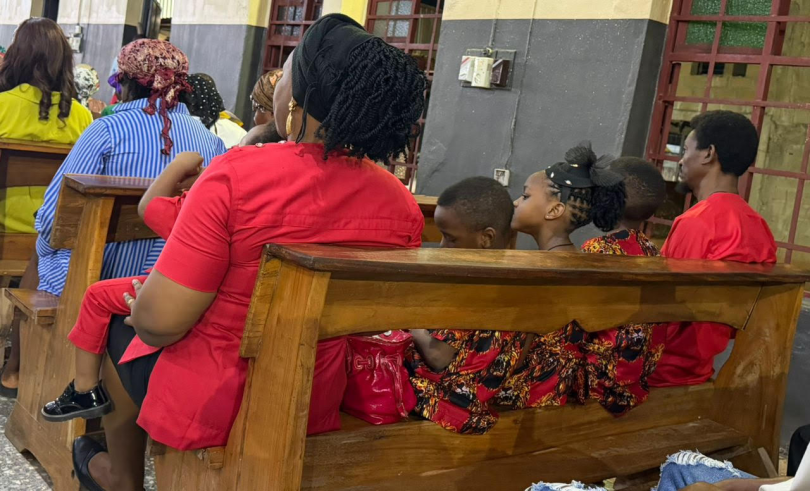
JUST have a look at the picture attached. Did you notice that the family is dressed entirely in red, including the mother’s handbag? Do you know why? It is informed Catholics living according to the dictates of the time. It is the same reason that informed the use of the red chasuble at today’s service. Red is used because Pentecost celebrates the coming of the Holy Spirit upon the apostles like fire, empowering the Church for mission. So, thumbs up to that family. I have deliberately avoided showing their faces for privacy reasons.
Did you also observe that from Easter Sunday up till today, all the first readings have come from the New Testament rather than the Old? This is intentional. The Church, after the Resurrection, shifts our attention to what followed it – how the apostles and early Christian communities lived, preached, and grew in faith. That is why the first readings during this period are drawn from the Acts of the Apostles. It is the Church’s way of letting us walk through the lived experience of the Resurrection.
This liturgical arrangement testify to the remarkable organisation and theological depth of the Catholic Church. The Church is a masterpiece of administrative genius, social discipline, and collective wisdom. The longevity and resilience of the Church come precisely from the fact that its policies, doctrines, and laws were not the hasty ideas of a single generation but the accumulated judgment of the finest minds across many centuries.
Because of its divine foundations built on the immutable basis of the Bible, tradition and the Magisterium, the Church wisely avoids changing its core doctrines to please the skeptical “reason” of any single era. By relying on a vast treasury of precedents hammered out by centuries of its best minds, it has achieved an institutional balance that outlasts every empire that tried to compete with it. It is not a system built on improvisation but one refined over centuries of prayer, reflection, and disciplined reasoning. When one pays attention to these patterns, one begins to appreciate the coherence and depth behind Catholic worship.
It is within this context of structured liturgical wisdom that today’s experience of Pentecost becomes even more meaningful. Today is Pentecost, and I attended the 5:30 a.m. Mass at St. Joseph the Worker Parish because of other commitments. The young priest, Fr. Lawrence Akwuba, gave a very solid homily. Catholic priests, always properly and profoundly formed, are among the best-prepared ministers of the Word – though, like in every institution, there are always individuals who fall short of expectations.
He began by situating Pentecost as the culmination of Eastertide and explaining its roots as a Jewish feast, fifty days after Passover, known as Shavuot. For Christians, however, it assumes a far deeper meaning: the descent of the Holy Spirit upon the apostles, as recorded in the Acts of the Apostles.
Fr. Akwuba described it as a decisive moment in the life of the Church – the very birth of the Church itself. The Spirit of truth, whom Christ promised in the Gospel of John, is now given in fullness to the apostles. Jesus had assured them that they would not be left orphans but would receive “another Advocate” to remain with them.
This event, he emphasized, is one of the most profound expressions of divine love: God not only gives His Son for our redemption but also gives His Spirit to sanctify, guide, and strengthen the faithful. Through this indwelling Spirit, believers are adopted as children of God and drawn into deeper communion with Him.
The homily further reflected on the gifts of the Holy Spirit, namely: wisdom, understanding, counsel, fortitude, knowledge, piety, and fear of the Lord, as a permanent disposition bestowed at baptism and strengthened in confirmation. These are, Fr. Akwuba fired on, abiding gifts that perfect virtue within the believer and orient the soul toward divine promptings.
From this flows a moral responsibility: those who have received the Spirit are called to bear visible fruits of that presence. The Christian life, therefore, becomes a continual examination of conscience – what fruits are we producing? The Spirit is not imposed; He invites cooperation, requiring openness, discipline, and docility to divine inspiration.
The priest concluded with a prayer that God would rekindle anew the fire of the Spirit within the faithful, so that their lives may more fully reflect the presence, power, and holiness of God.
There are several important theological implications arising from Pentecost that deserve closer reflection. The presence of Mary, the mother of Jesus, among the apostles in the upper room, as recorded in the Acts of the Apostles 1:14, is highly significant. The one who received the Holy Spirit at the Annunciation is also present when the Spirit descends upon the Church at Pentecost, forming a theological continuity between Christ’s conception and the Church’s birth.
Another important dimension is found in John 20:21–23, where the risen Christ breathes on the apostles and says, “Receive the Holy Spirit.” Immediately after this, He declares: “As the Father has sent me, so I send you.” This moment is foundational. It reveals not only the gift of the Spirit but also the institution of apostolic mission. The apostles are not acting as private individuals but as representatives of Christ Himself. This is the biblical root of apostolic succession – the transmission of authority and mission from Christ to the apostles, and from the apostles to their successors.
It is also within this same passage that the Church finds strong biblical grounding for sacramental reconciliation. When Christ says, “Whose sins you forgive are forgiven them, and whose sins you retain are retained,” the authority to forgive sins is clearly entrusted to the apostles as ministers acting in Christ’s name. This is the theological foundation for auricular confession. It is not a human invention but a continuation of Christ’s own divine authority exercised through His appointed ministers.
From this perspective, Pentecost is not only the outpouring of the Holy Spirit but also the public manifestation of a structured, sacramental, and apostolic Church. The Spirit does not create disorder; He establishes and animates a visible communion rooted in Christ’s own commissioning of the apostles. This is why the Church understands itself as “one, holy, catholic, and apostolic” – not as a collection of isolated communities preaching different variants of the news, but as a living continuity of the apostolic foundation.
Thus, what emerges from Pentecost is a deeply integrated vision: Mary in prayer with the Church, the Spirit empowering the apostles, Christ instituting mission and forgiveness, and the birth of a structured ecclesial body that continues through apostolic succession.
Happy pentcost Sunday to you all.
A.I
May 25, 2026
Tags: Valentine Obienyem
