
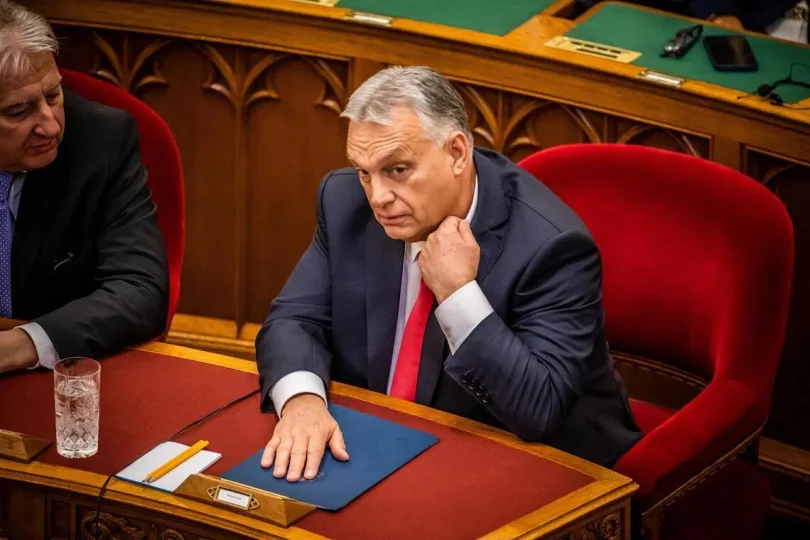
BUDAPEST – Outgoing Prime Minister Viktor Orban’s crushing election defeat has thrown the Hungarian nationalist’s political future into doubt and shattered his reputation as an all-powerful leader.
While senior members of Mr Orban’s Fidesz party seem to have closed ranks behind him, rare public dissent from the party has seeped out, and analysts say it will be difficult to recover from the landslide loss that ended his 16-year rule.
Last week, Mr Orban – who aimed to make the central European country of 9.5 million people a model of “illiberal democracy” – announced he would not take up his parliamentary seat, saying he was needed for the “reorganisation of the national camp”.
This marks the first time the 62-year-old – who has cultivated close ties with US President Donald Trump and Russian President Vladimir Putin – will be absent from Parliament since Hungary’s democratisation in 1990.
Mr Orban was routed in the April 12 elections by newcomer Peter Magyar, whose party won with 55 per cent, securing a two-thirds majority in parliament, on the promise of “regime change”.
Mr Orban’s Fidesz-KDNP alliance lost more than half its parliamentary seats, getting 39 per cent of the vote.
Following the loss, Mr Orban on April 28 offered to resign as Fidesz leader, but the party’s national board reportedly rejected his resignation.
He is expected to run unopposed for the post at a Fidesz congress on June 13, as analysts say his grip on the party remains firm as ever.
“He turned Fidesz into his personal party, where the primary unifying force is admiration, respect, loyalty or a mixture of these towards him,” Mr Szabolcs Dull, who runs the political podcast Otpontban, told AFP.
But the election results have prompted some rare criticism from within Fidesz.
Outgoing lawmaker Orsolya Ferencz, 55, insisted the party needed to learn from the loss, which she compared to a “divine judgment”.
“The responsibility of certain politicians, business circles, think tanks and the media must be examined,” she told AFP, but declined to be more specific.
“The lack of morality, often manifesting as the pursuit of financial (gain) or power at all costs, adverse selection, and the trampling of professionalism, is unacceptable.”
But Ms Ferencz stressed it was up to Mr Orban to decide what kind of role he seeks in “rebuilding” their political community, lauding him for his “historic accomplishments”.
Mr Orban managed to bounce back once before: Ousted in 2002 after his first term as premier, he returned eight years later.
“He has a unique capacity for adaptability, and resilience in Hungarian politics,” said Mr Zoltan Novak, project director at the Centre for Fair Political Analysis.
“But now his presence jeopardises renewal, because he represents the 16-year period that voters have overwhelmingly rejected,” he added.
Incoming premier Magyar, 45, has pledged to enshrine a two-term limit in the constitution for prime ministers, theoretically preventing Mr Orban’s return to power.
Some Fidesz voters have felt deceived – with Mr Orban’s allies insisting even on election night that polls predicted their win.
A fresh survey from pollster Median found Fidesz had lost about a third of its support base post-election.
It also indicated that almost half the population – even 18 per cent of Fidesz voters – believe Mr Orban’s coalition lost because of corruption.
Mr Magyar put the issue at the forefront of his campaign, blaming underfunded public services on allegedly corrupt oligarchs.
The pro-EU conservative has pledged a sweeping crackdown on corruption, urging authorities to stop Fidesz cronies from moving their capital abroad to the “United States, Uruguay and the United Arab Emirates” until then.
But Mr Orban, in his sole post-election interview, denied graft was ever a problem under his governance, putting the blame on business associates “flexing” their wealth.
He is “unable” to admit this, because “corruption and avoiding responsibility” were the main features of Mr Orban’s system, according to Dr Rafael Labanino, a political scientist from Germany’s Nuertingen-Geislingen University.
Dr Labanino said he expects Mr Orban’s position will deteriorate further as the generous state funding pro-Fidesz media enjoyed over the past 16 years will “dry up”. AFP