
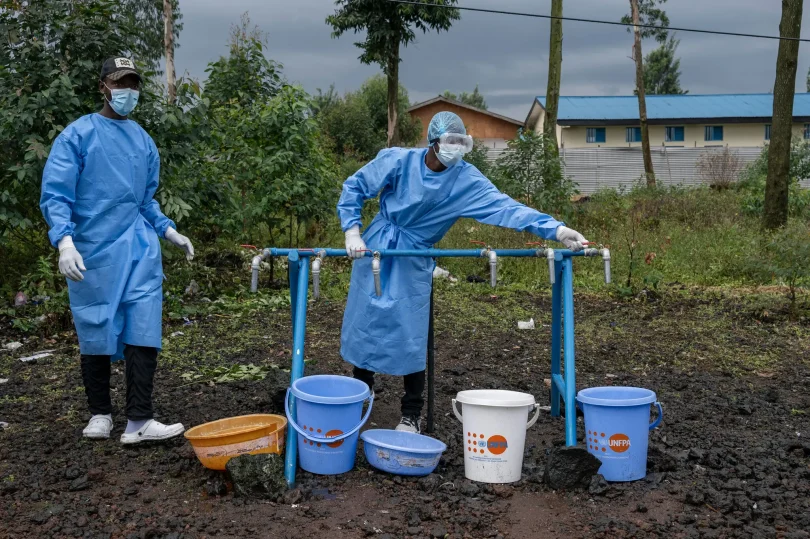
Nigeria has stepped up Ebola surveillance at airports, border communities and health facilities after a fast-spreading outbreak in the Democratic Republic of Congo and Uganda raised fears of wider regional transmission across Africa.
The Nigeria Centre for Disease Control and Prevention said the country has not recorded any confirmed case linked to the ongoing outbreak. However, the agency warned that the risk of importation remains high because of international travel, population movement and the rising number of suspected cases in affected East and Central African countries.
The outbreak, centred in eastern Democratic Republic of Congo, is suspected to have caused more than 170 deaths and about 750 infections, according to the World Health Organization.
WHO Director-General, Tedros Adhanom Ghebreyesus, said the outbreak was “spreading rapidly” in eastern Congo, with fears that the true scale may be larger than initial figures suggest.
“We are now revising our risk assessment to very high at the national level, high at the regional level and low at the global level,” he told reporters in Geneva.
The WHO had earlier declared the outbreak a public health emergency of international concern and warned that it could last for months, although it was unlikely to pose a global threat.
The latest outbreak has drawn concern because it involves the Bundibugyo strain, a rare type of Ebola virus. Health officials say the strain is harder to contain because fewer field tests are available, and there is no targeted vaccine or specific treatment for it.
Most of the reported cases have been in Congo, but Uganda has also confirmed new infections. On Saturday, Ugandan health officials confirmed three new cases, bringing the country’s total to five. Two cases, including one death, were linked to people who had travelled from neighbouring Congo.
Uganda’s health ministry said a driver and a health worker who had been exposed to the country’s first confirmed case had fallen ill and were receiving treatment. Another case involved a Congolese woman who entered Uganda by chartered flight and was being treated at a private hospital in Kampala.
The outbreak was first identified in May in the Democratic Republic of Congo’s northeastern Ituri Province. The region has large numbers of people displaced by conflict, as well as migrant workers drawn to its gold mines. Health officials say population movement in the area has increased the risk of the virus spreading across borders.
The outbreak has been concentrated mainly in Ituri and North Kivu. A death has also been reported in South Kivu, where the M23 rebel group controls a large area. Violence and insecurity in eastern Congo have made it harder for health workers to trace contacts, test suspected cases and control the outbreak.
For families in affected communities, the outbreak has revived fear of previous Ebola emergencies, when movement restrictions, pressure on hospitals and the loss of loved ones disrupted daily life. Health workers are also under heavy pressure to identify suspected cases early while protecting themselves from infection.
In Nigeria, the NCDC said its latest risk assessment identified border communities, major transport hubs and international points of entry as high-risk areas requiring stronger monitoring.
“This assessment estimated the risk of Ebola importation into Nigeria as high due to the ongoing transmission in the DRC and Uganda, international travel and population movement, uncertainty regarding the full magnitude of the outbreak, and the potential for delayed recognition because symptoms may overlap with endemic diseases such as malaria and Lassa fever,” the advisory stated.
The agency said the National Emergency Operations Centre had been placed on alert mode, while the National Incident Management System had been activated to coordinate response activities across the country.
Epidemiologists and Rapid Response Teams have also been placed on standby for possible deployment to any state if required.
The NCDC said it was working with state ministries of health, Port Health Services and other relevant government agencies to improve national readiness. Surveillance and epidemic intelligence activities have also been intensified across the country.
According to the agency, this includes enhanced monitoring of unusual public health events, rumours and alerts to ensure early detection of suspected cases.
“Enhanced surveillance activities are also ongoing at points of entry and border communities,” the agency said.
As part of infection prevention efforts, Ebola preparedness tools and checklists have been distributed to healthcare facilities nationwide. Refresher training is also ongoing for health workers on triage systems, infection prevention protocols and early identification of suspected viral haemorrhagic fever cases.
States have been advised to designate isolation and treatment centres, assess bed capacity, improve logistics systems and ensure the availability of emergency medical supplies.
The agency said plans were underway to preposition critical response materials, including personal protective equipment, body bags, laboratory consumables and other emergency supplies, in strategic locations across the country.
On laboratory preparedness, the NCDC said Nigeria currently maintains testing capability in states with international ports of entry and within the national public health laboratory network. It added that surge capacity for Ebola testing remains available if necessary.
Nigeria has faced Ebola before. The country successfully contained an outbreak in 2014 after imported cases were detected, a response that was widely praised and remains a major reference point for public health preparedness in Africa.
SEE Full Details ➜