
Business
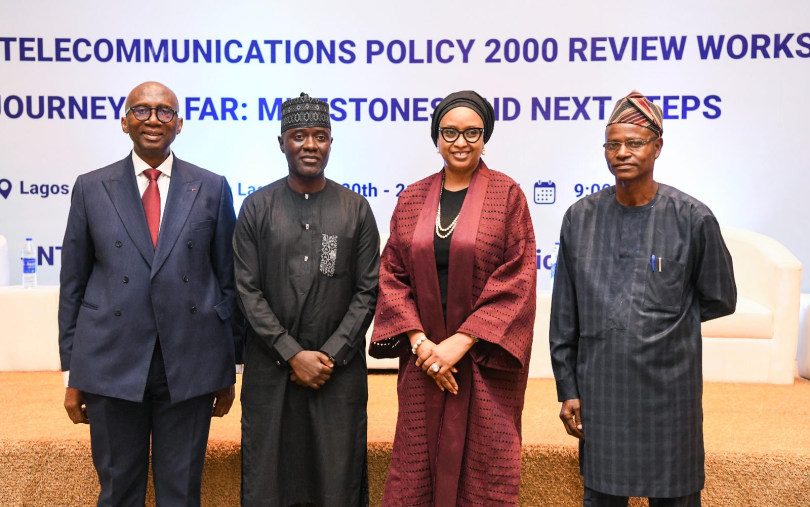
Photo caption: L- R: Ernest Ndukwe, board chairman, MTN; Aminu Maida, EVC/CEO NCC; Hadiza Bala Usman, Special Adviser to the President on Policy Coordination; Festus Daudu, former permanent secretary, Federal Ministry of Communications, Innovation and Digital Economy (FMCIDE) at the National Telecommunications Policy 2000 Review Workshop at the Marriott Hotel, Ikeja, Lagos. 20/05/2026.
…explains the need for a review of the National Telecommunications Policy 2000
By Victoria Frances
AMINU Maida, executive vice chairman of the Nigerian Communications Commission (NCC), has said that telecommunications has become a productivity infrastructure for the country’s entire economy, hence the need for a review of the National Telecommunications Policy 2000.
“Telecommunications is no longer just one sector within the economy; it is a productivity infrastructure for the entire economy. It supports commerce, agriculture, manufacturing, transport, financial services, education, health, public administration, and the everyday productivity of millions of Nigerians,” Maida told the audience at the workshop attended by telecommunication experts and policy wonks, including Ernest Ndukwe, board chairman of MTN and former executive vice chairman of the NCC, and Hadiza Bala Usman, special adviser to the President on Policy Coordination.
This expanded role of telecommunications is the timely reason the workshop was convened to review the National Telecommunications Policy 2000. As the EVC pointed out, the policy helped build the market we have today, but the market has outgrown the assumptions of that period. “Our task is to preserve the enduring principles of competition, universal access, independent regulation, and consumer protection, while developing a modern policy framework that supports broadband expansion, innovation, investment, resilience, quality of experience, and Nigeria’s ambition to build a truly inclusive digital economy.
“We must also approach this review as an economic development exercise, not simply a sectoral policy update. The GSMA has estimated that deeper digitalisation across agriculture, manufacturing, transport, trade, and government could add around two percentage points to GDP by 2028, create nearly two million jobs, and generate an additional ₦1.6 trillion in tax revenue.”
He stated that the policy choices made at the workshop would determine not only the future of the telecommunications industry, but also Nigeria’s ability to broaden its tax base, improve public service delivery, raise productivity, formalise more businesses, create jobs, and build a more inclusive and resilient economy. “In other words, we must move beyond celebrating connected lines alone. We must now focus on cross-sectoral productivity, digital adoption, quality of experience, and GDP growth enabled by meaningful connectivity. Regulation in Nigeria has also matured significantly since the National Telecommunications Policy 2000. At the time, the priority was market liberalisation: moving from a command-and-control environment to one that could support competition, private investment, and mass access. Over the years, our regulatory model has evolved from opening the market, to enabling investment and access, to managing convergence, competition, consumer protection, spectrum, broadband expansion, and quality of service.”
Realnews reports that the ITU’s assessment captures this progression clearly. Nigeria has moved from first-generation regulation, through market liberalisation and mobile competition, and is now classified as a fourth-generation regulatory environment, with advanced readiness for fifth-generation collaborative digital regulation. This reflects a wider shift in the role of the regulator. The NCC is no longer only licensing operators and supervising a telecommunications market; it is helping to enable a digital economy.
Today, the executive vice chairman said that “regulation must support broadband infrastructure, digital financial services, cybersecurity, identity systems, e-government, data governance, consumer trust, innovation, and critical infrastructure protection. That requires collaboration with institutions such as NDPC, CBN, FCCPC, NITDA, NIMC, ONSA, state governments, and other public bodies.
“In this sense, the next telecommunications policy must recognise that regulation has moved from sector oversight to ecosystem stewardship—from managing telecommunications services to enabling Nigeria’s broader digital transformation. It is against this backdrop that the Commission has convened this Workshop as part of a public consultative process to review the existing policy framework and chart a new course for the future of telecommunications in Nigeria.”
According to him, the workshop was carefully designed to achieve several critical objectives: to review the implementation of the National Telecommunications Policy 2000; identify its successes, challenges, and gaps; engage stakeholders on policy proposals published by the Commission; and develop actionable recommendations towards the emergence of a forward-looking National Telecommunications Policy 2026.
The calibre of participants assembled for the workshop, he said, “reflects the importance of this national assignment. Over the next two days, we will hear from individuals who played pivotal roles in the birthing and implementation of the National Telecommunications Policy 2000, as well as industry pioneers, former regulators, international organisations, development institutions, policy experts and current market participants. Their insights and experiences will enrich our deliberations.”
As he pointed out, the workshop is not only about looking back at the policy that served its time well and helped open the market, attract private investment, promote competition, and lay the groundwork for stronger independent regulation. It was later reinforced by the Nigerian Communications Act 2003, which, within a decade, saw Nigeria move from scarcity to rapid expansion, from limited fixed-line service to tens of millions of active connections, and from a monopoly to one of Africa’s most dynamic telecommunications markets.
But he stated that the next phase was the network-building era because, as access expanded, the question shifted from simply connecting people to building the infrastructure required for broadband, data, and digital services. “Regulatory attention increasingly moved to spectrum planning, fibre deployment, rights of way, infrastructure sharing, co-location, open access, quality of service, and universal access. That phase also exposed structural challenges that continue to affect the sector today: fibre cuts, vandalism, high energy costs, multiple taxation, permitting delays, and persistent gaps between urban and rural connectivity.”
These are not just operational issues for operators; they are national development issues because they affect the quality, resilience, and reach of digital services across the economy. By the mid-2010s, telecommunications had become the platform for a much wider digital ecosystem. Banking, commerce, fintech, education, entertainment, government services, cloud platforms, social media, and digital identity increasingly began to depend on telecom networks.
The regulatory task, therefore, expanded beyond operators and infrastructure to include consumer protection, cybersecurity, data governance, digital financial inclusion, online safety, competition across digital platforms, and closer collaboration with other regulators and public institutions.
Today, we are in a fourth era: the era of advanced regulatory frontiers. The issues before us now include 5G, artificial intelligence, satellite broadband, Internet of Things, cloud infrastructure, critical national information infrastructure, digital trust, network resilience, and sustainable investment. This is no longer a narrow telecommunications conversation.
It is about asking what kind of policy framework Nigeria needs for the next phase of digital transformation. The future of telecommunications can no longer be discussed in isolation. The issues before us touch on broadband infrastructure, cybersecurity, digital trust, regulatory coordination and convergence, artificial intelligence, internet governance, data protection, investment sustainability, quality of service, and meaningful connectivity for all Nigerians.
“As regulators, policymakers, operators, and stakeholders, we must collectively develop a policy framework that addresses current realities while anticipating future disruptions and opportunities. We aspire to develop a modern telecommunications policy that supports innovation while protecting consumers; promotes investment while fostering competition; strengthens regulatory collaboration; improves quality of experience; and advances Nigeria’s broader digital economy objectives,” he said.
He acknowledged particularly the support and leadership of the Federal Ministry of Communications, Innovation and Digital Economy in driving reforms and strategic initiatives aimed at accelerating Nigeria’s digital transformation agenda. He also commended all stakeholders who submitted comments, recommendations, and policy proposals ahead of this Workshop, adding: “Your contributions demonstrate the collective commitment required to shape a telecommunications ecosystem that works for every Nigerian.”
A.I
May 21, 2026
Tags: Aminu Maida CBN Ernest Ndukwe FCCPC Festus Daudu HADIZA Bala Usman NCC NDPC NIMC NITDA ONSA