
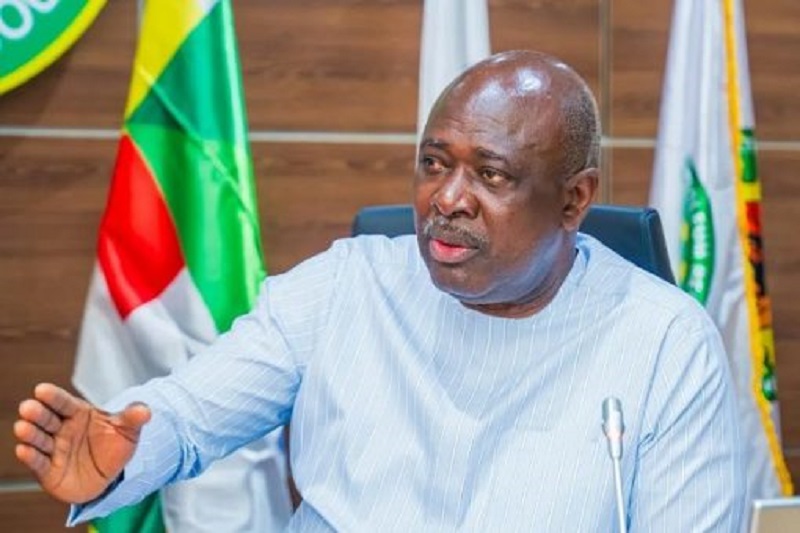
The Minister of State for Petroleum Resources (Oil), Mr Heineken Lokpobiri, is expected to outline Nigeria’s accelerating upstream transformation and its expanding role as one of Africa’s leading oil and gas investment destinations at the African Energy Week (AEW) 2026, scheduled to hold October 12-16 in Cape Town, South Africa.
Nigeria’s energy sector has recorded one of its strongest investment cycles in a decade, driven by regulatory reforms under the Petroleum Industry Act (PIA), improved fiscal incentives and renewed confidence from international oil companies (IOCs) and indigenous operators.
In 2025 alone, Nigeria approved 28 new Field Development Plans valued at $18.2 billion, unlocking an estimated 1.4 billion barrels of crude oil reserves, according to government disclosures. These approvals mark a decisive shift toward accelerating project execution timelines and reversing years of stalled upstream development.
Mr Lokpobiri has consistently credited this momentum to reforms under the PIA, alongside faster licensing processes and investment-friendly fiscal adjustments.
Speaking in Abuja earlier this year, he noted that Nigeria secured four of seven major Final Investment Decisions (FIDs) in Africa between 2024 and 2025, positioning the country as a leading upstream investment hub on the continent.
A central pillar of this resurgence is Shell’s Bonga deepwater complex, where the company has taken a $5 billion final investment decision on the Bonga North project, a subsea tie-back expected to add over 300 million barrels of recoverable resources and significantly boost long-term output from the FPSO hub. The development is widely viewed as a benchmark for Nigeria’s renewed deepwater competitiveness.
Meanwhile, ExxonMobil’s planned investment in the Usan deepwater oil field is expected to inject up to $1.5 billion between 2025 and 2027, supporting production revitalisation through new drilling and infrastructure upgrades.
Alongside IOC-led expansion, Nigeria’s indigenous producers are increasingly central to near-term output growth, with Heirs Energies targeting up to 100,000 barrels per day as it ramps up development across its onshore Niger Delta portfolio, including OML 17.
According to a statement from the African Energy Chamber (AEC), this momentum is complemented by Seplat Energy’s optimisation of its expanded onshore portfolio following the ExxonMobil acquisition, reinforcing the growing role of local operators in stabilising production and driving Nigeria’s short-term output gains.
Mr Lokpobiri is also expected to highlight Nigeria’s broader energy transition framework at AEW 2026, which seeks to balance oil production growth with gas monetisation, domestic refining expansion and increased local content participation. His policy messaging has consistently emphasised that Nigeria’s oil and gas sector is structured to accommodate both IOCs and a growing base of indigenous operators.
“Nigeria is once again proving what is possible when policy meets execution,” said NJ Ayuk, Executive Chairman of the African Energy Chamber. “Under leaders like Heineken Lokpobiri, we are seeing renewed seriousness about production, investment and getting projects across the line – from deepwater developments to indigenous-led growth. This is exactly the kind of momentum Africa needs: not promises, but barrels, projects, and bankable deals.”
SEE Full Details ➜