
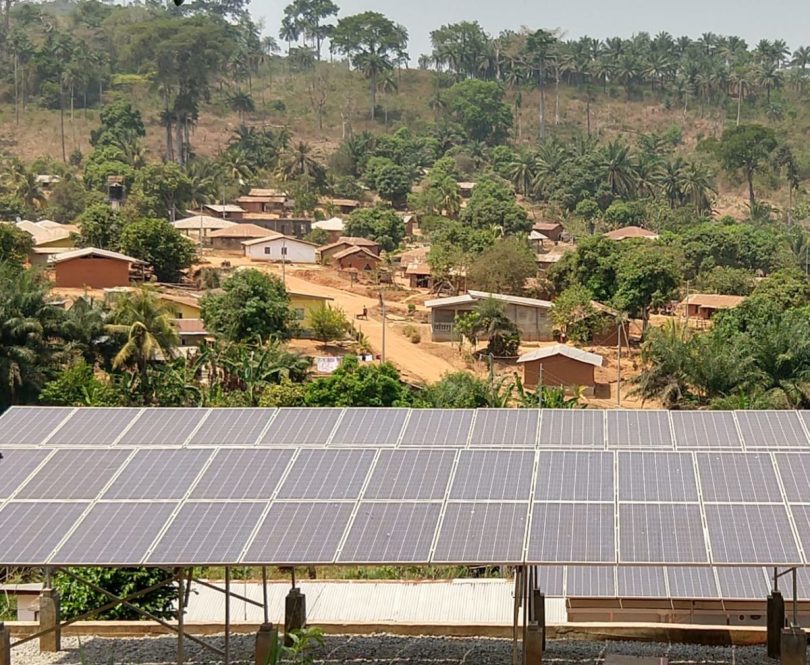
The World Bank’s financing arm, the International Finance Corporation (IFC), and the Norwegian investment fund (Norfund) have committed up to $83.2 million to expand solar hybrid mini-grids across Nigeria, in a move expected to connect nearly half a million new users to electricity.
The funding will support five renewable energy companies, Darway Coast Nigeria Limited, GVE Projects Limited, Prado Power Limited, PriVida Power Limited and StarTimes Energy, to build 315 mini-grid sites across underserved communities.
The projects are projected to deliver about 494,189 new electricity connections. Renewable energy solutions
IFC says the intervention is aimed at closing Nigeria’s massive electricity gap, noting that more than 85 million people in the country still live without access to power.
The institution said expanding distributed renewable energy will not only improve electricity access but also cut energy costs and support small businesses in rural areas.
According to IFC, “By supporting distributed renewable energy solutions, this initiative will help expand access to reliable electricity while reducing energy costs, strengthening local economies, and enabling income-generating activities.”
For operators already working in the sector, the new funding is expected to speed up expansion plans.
The chief executive of Darway Coast Nigeria Limited, Mr Henry Ureh, said the support will allow companies to scale faster and reach more communities that have remained off the national grid for years.
“Access to reliable electricity allows us to expand our operations, support local businesses, and create jobs in the communities we serve,” he said.
Nigeria’s off-grid power space has been growing steadily, but access remains uneven. Data from the Africa Solar Industry Association shows that the country currently has over 4.8 gigawatts of installed solar capacity, but only about 115 megawatts come from mini-grids serving rural communities.
The IFC has been one of the biggest institutional backers of this segment. Last year, it announced a separate $16 million financing package for Nigerian developer Virtuitis to build 97 mini-grids expected to serve over 140,000 off-grid consumers by 2027, showing a steady increase in international interest in decentralised power solutions.
With grid supply still unreliable in many parts of the country, mini-grids are increasingly becoming the most practical solution for rural electrification as they supply adequate but limited power for limited power consumption.
For many communities, the impact goes beyond electricity. Reliable power is expected to support trading activities, agro-processing, small manufacturing and education, all of which have struggled under years of unstable supply. But operators also warn that sustained policy support and stable regulation will be key to scaling beyond pilot-level projects.
As deployment begins across the 315 sites, observers are keen on understanding how quickly these projects can move from funding to actual connections to where they are needed.