
Environment
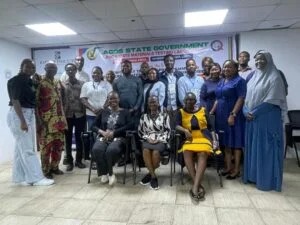
Participants at a two-day technical training for registered private materials testing laboratories on Wednesday in Lagos
THE Lagos State Materials Testing Laboratory Agency (LSMTL) has urged registered private materials testing laboratories to ensure credible, accurate and dependable reports to safeguard and strengthen the built environment.
The News Agency of Nigeria (NAN) reports that the advice was given by stakeholders at the beginning of a two-day technical training for registered private laboratories.
The event was organised by LSMTL on Wednesday in Ikeja.
The training had the theme: “The Strategic Role of Private Laboratories in Materials Testing: Through Detailed Report Writing, Data Integrity and Quality Assurance.”
The Permanent Secretary, Office of Works, Lagos State, Mrs Bolanle Olukare, said the training came at a time when Nigeria was grappling with building collapse and infrastructure failure.
She said that quality in construction, infrastructure and manufacturing depended on reliable data, stressing that laboratory professionals played a central role in ensuring accuracy and safety.
“This training comes at a critical time when we know that we have issues in our nation, particularly building collapse, and we rely on professionals to ensure such situations are avoided,” she said.
Olukare said that laboratory experts were responsible for testing materials correctly, interpreting results accurately and honestly, and applying standards without compromise.
“You are the ones who know how to test materials correctly, interpret results accurately and honestly, and apply standards without cutting corners,” she said.
She described technical consultants as occupying a critical position at the intersection of science and standards, urging them to take the training seriously.
“Lives depend on it,” she warned.
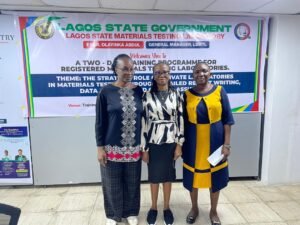
The General Manager of LSMTL, Mrs Olayinka Abdul, described private laboratories as critical partners in safeguarding public safety and ensuring structural integrity of buildings and infrastructure across Lagos State.
Abdul said that government alone could not test every construction material, stressing that accredited private laboratories served as co-gatekeepers of quality and safety.
“When a private laboratory issues a test report, that document carries the same weight as one from a public laboratory.
“It influences approvals for foundation casting, superstructure works, road construction and other critical infrastructure,” she said.
The general manager emphasised that trust in laboratory reports would rest on three pillars: detailed report writing, data integrity and quality assurance.
According to her, test reports must go beyond numerical results to include comprehensive details on sampling procedures, standards used, testing conditions and explanations for any failed samples.
“A report without detail is merely an opinion; with detail, it becomes a legal and engineering fact,” Abdul said.
On data integrity, she warned that the agency would not tolerate falsification of test results.
“Any laboratory found guilty of manipulating results will be delisted, de-accredited and prosecuted.
“A single altered result can lead to building collapse and loss of lives,” she said.
Abdul also announced that from the next quarter, the agency would introduce a quality assurance scorecard for all registered private laboratories.
She said laboratories scoring below 70 per cent in unannounced inspections would be suspended, while those scoring 90 per cent and above would receive priority referrals for government projects.
Earlier, the Director of Research and Development in the agency, Mrs Titilayo Lawal, said the training was a strategic intervention aimed at addressing recurring issues of poor testing practices and weak reporting standards.
Lawal said investigations by her department had shown that many structural failures in Lagos were linked to poor testing or absence of testing.
She said that the workshop participants would be trained on forensic-grade report writing, internal data verification protocols, proficiency testing and preparation for enhanced audit procedures.
According to her, every participating laboratory will receive a blind proficiency testing sample on the second day of the programme and will be required to submit results within seven working days.
“Labs that fail the blind test will undergo remedial audits. This is not punishment, but partnership through accountability,” she said.
Lawal urged the participants to view themselves as partners with the state government in protecting lives and property through credible and professional laboratory practices.
One of the participants, Mrs Folake Adeke, Managing Director, Nazeema Engineering, commended the LSMTL for organising the workshop at a critical time.
Adeke said that the workshop was relevant in addressing challenges in the construction industry, especially building collapse.
She identified report writing, data integrity, and quality assurance as the most important aspects of the training.
She noted that the areas were central to the effectiveness and credibility of materials testing laboratories and essential to ensuring safe construction and preventing building collapse in Lagos.
She said that proper laboratory practices directly supported structural safety and public confidence.
The first day of the two-day workshop had heads of registered private materials testing laboratories, technical partners, industry stakeholders, engineers and consultants in attendance. (NAN)
F.O
Tags: building collapse