
Featured, Judiciary
…as court declares police action illegal
By Anthony Isibor
A High Court of the Federal Capital Territory, FCT, Abuja, presided over by Justice O. A. Musa, has delivered judgment in favour of Elvis Eze Emecheta in a protracted Lekki land dispute, condemning the misuse of police powers and ordering the enforcement of a multi-billion naira property agreement.
The ruling, which was delivered on April 23, in Suit No. CV/4636/2025, centres on a contested 3,000 square metres of reclaimed land at Lekki Peninsula Scheme, Lagos, valued at about N2.4 billion, involving Henry Ugonna Orabuchi and the Nigeria Police Force.
The case is between Henry Ugonna Orabuchi, the applicant and the Nigeria Police Force, 1st respondents, the Inspector General of Police, 2nd respondents, ACP Magaji K. Mohammed, (assistant commissioner of police, head, IGP Monitoring Unit), 3rd respondents, SP Abigail Patrick, 4th respondents, Emecheta Elvis Eze, 5th respondents, the commissioner for Physical Planning and Urban Development, Lagos State, 6th respondents and The Federal Ministry of Housing and Urban Development, 7th respondents.
Justice Musa firmly rejected the preliminary objection raised by the 5th respondent, ruling that the suit was properly brought under the Fundamental Rights (Enforcement Procedure) Rules.
The judge stressed that the success of the claim was not the issue at that stage since the action was clearly anchored on constitutional rights, and described the objection as lacking merit and one that “fizzles into insignificance,” before dismissing it.
A crucial turning point in the case was the failure of the police and other respondents (1st–4th, 6th and 7th) to file any counter-affidavit despite being duly served.
The court held that their silence meant the applicant’s claims stood unchallenged and were deemed admitted in law, provided they were credible. Justice Musa reiterated that fundamental rights occupy a central place in Nigeria’s constitutional framework and must be protected through a liberal and purposive interpretation.
On the substance of the case, the court found clear evidence that law enforcement machinery was deployed to enforce what was essentially a civil contract.
The court noted that the matter was already under investigation by police authorities in Zone 2, Lagos, yet a parallel petition was filed in Abuja. It also found that the applicant faced threats of arrest and was subjected to detention, notwithstanding a Director of Public Prosecution’s recommendation said to be adverse to the 5th Respondent.
The judge described the situation as a “troubling and disquieting scenario,” pointing to abuse of process, forum shopping, and a calculated attempt to undermine the administration of justice.
The court reaffirmed the established legal position that the police are not debt recovery agents and must not be used to settle contractual disputes.
It held that the actions of the respondents, particularly the use of police processes in a civil matter, amounted to a violation of the applicant’s fundamental rights.
Consequently, the court granted the core reliefs, declaring that the applicant’s rights to personal liberty, freedom of movement and property had been violated.
It also declared that the police invitation dated November 11, 2025, was unconstitutional, null and void, and set it aside. The court further held that law enforcement authorities cannot, under the guise of investigation, interfere in purely civil contractual matters, and restrained them from further harassment, arrest or detention in connection with the dispute.
In a decisive aspect of the judgment, the court held that the contractual relationship between the parties created not only contractual rights but also an equitable interest in the land, protected under Section 44 of the Constitution.
Justice Musa noted that the existence of the contract was not in dispute, that full payment had been made, and that performance could not be delayed indefinitely.
Applying equitable principles, the court ordered specific performance, directing Emecheta Elvis Eze to fulfil his obligations under the contract forthwith.
It further restrained the Federal Ministry of Housing and Urban Development from processing or granting any Certificate of Occupancy over the disputed land pending compliance with the order, holding that any such action could extinguish the applicant’s constitutional property rights.
Despite the rulings on rights violations, the court declined to award damages or order a public apology, ruling that the claims were premature, particularly as the applicant’s detention had been prevented by earlier interim orders of the court.
Reliefs relating to damages were accordingly refused, while a request seeking ongoing supervision of the property by Lagos State authorities was struck out as incompetent.
Among its final orders, the court nullified the police invitation, restrained further police interference, ordered specific performance of the land contract, restricted any issuance of title over the property pending compliance, and directed that the property earlier sealed during the dispute be unsealed by the police.
This court ruling brings clarity to a dispute that has lingered since 2023, when Sir Elvis Emecheta, owner of the property entered into a contract with Ugonna Orabuchi for the sale of approximately 3,000 square metres from part of reclaimed waterfront land located at the rear of Plot A, Block 12, Lekki Peninsula Scheme.
Under the agreement, the buyer paid the full consideration of about N2.4 billion, with the understanding that the seller would complete reclamation, perfect title documentation, and subsequently transfer possession and legal interest in the land.
However, disagreements soon emerged over the execution of the agreement.
While Ugonna Orabuchi maintained that he had fulfilled all financial obligations and was entitled to immediate possession and title, Emecheta insisted that the land formed part of a larger reclamation project and that transfer could only occur after the completion of title regularisation processes with the relevant government agencies.
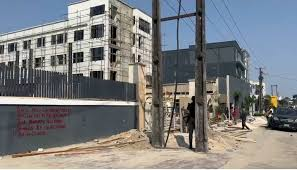
“The contract of sales agreement states clearly that 3000sqm sold to Mr Orabuchi will come with legal title that must be procured by me after reclamation. But before that’s done, Orabuchi went into the land being reclaimed to partition it into 3 sections and barricaded the entire land.
“In doing so, he chased away legal tenants conducting their businesses on the old property of mine adjoining the reclaimed land which has nothing to do with the reclaimed land. It was this criminal and self help conduct that necessitated reporting to police for which he was promptly invited for questioning. Instead of answering Police, he filed a suite at FCT High Court through his lawyer, Ojukwu, SAN to stop police invitation and investigation, Emecheta, said.
Realnews reports that the Abuja high court granted Oranuchi relief under fundamental rights protection. He capitalized on that to seal the businesses of legal tenants on the adjoining land as well as the entire reclaimed land. “So for four months the property housing other businesses plus reclaimed was sealed following the court exparte order granted Justice Othman Musa,” he said.
A.I
May 1, 2026
Tags: ACP Magaji K. Mohammed Elvis Eze Emecheta Henry Ugonna Orabuchi Justice O. A. Musa