
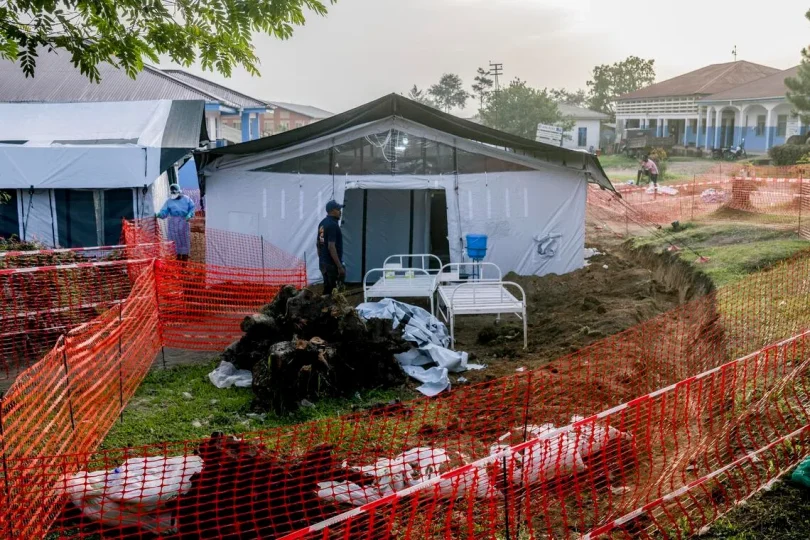
Ebola may have killed more than 200 people so far in Democratic Republic of Congo, where violence, mistrust and overwhelmed surveillance systems are straining efforts to contain the virus in the country’s conflict-hit east.
More than 900 suspected cases have been reported across 11 health zones spanning three eastern provinces, according to health ministry data released late on May 24. Regional figures indicate cumulative suspected deaths reached 210 as of May 23.
The outbreak is exposing the difficulties of mounting an Ebola response in one of the world’s most unstable regions, where armed groups control territory, health systems are fragile and attacks on treatment centers have disrupted containment efforts. Health workers were able to follow up with only about 20 per cent of identified contacts in a single day, according to ministry data.
“The violence is forcing people to flee, including health and humanitarian workers,” World Health Organization Director-General Tedros Adhanom Ghebreyesus said on May 24 on social media. “This is severely impeding efforts to scale up Ebola contact tracing and identify infections early enough to provide supportive care.”
Angry residents stormed a hospital treating Ebola patients in the town of Mongbwalu late on May 24 after authorities refused to release bodies for burial because of infection risks, the Associated Press reported.
Earlier unrest in Ituri – the province along the Ugandan border where the outbreak was first detected and most cases are concentrated – led to Ebola treatment tents being set on fire and patients fleeing a treatment center, according to reports from the area.
Regional health ministers meeting in the Ugandan capital Kampala on May 23 warned that porous borders, active mining corridors and large population movements were increasing the risk of cross-border Ebola transmission.
Ten African countries are now considered at risk from the outbreak because of regional mobility and gaps in surveillance and diagnostic capacity, Africa Centres for Disease Control and Prevention Director-General Jean Kaseya said on May 24.
The crisis is being driven by the rare Bundibugyo strain of Ebola, for which there are no approved vaccines or antibody treatments. The WHO declared the epidemic a public health emergency of international concern on May 17. Uganda has also reported five confirmed cases linked to the outbreak.
An American infected while caring for Ebola patients in Congo had been evacuated to Germany for treatment, while high-risk contacts were moved to Germany and the Czech Republic, the US Centers for Disease Control and Prevention said. Bloomberg