
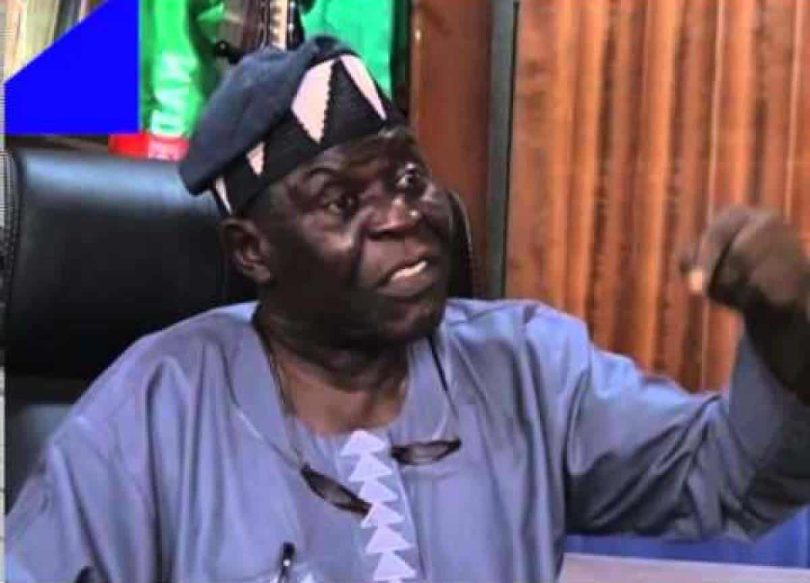
The General Secretary of the National Democratic Coalition (NADECO), Ayo Opadokun, has named prominent political, military and technocratic figures he alleged signed a document that paved the way for the nullification of the June 12, 1993, presidential election won by Chief MKO Abiola.
PrimeTimes Nigeria reports that the allegation is contained in Opadokun’s newly launched 509-page book, ‘The NADECO Story’, unveiled last week in Lagos.
In Chapter 27 of the book, Opadokun accused several leading figures in Nigeria’s political establishment of endorsing the Interim National Government arrangement following the military regime of Gen. Ibrahim Babangida’s annulment of the June 12 election.
Among those listed as signatories to the controversial document were former Chief of General Staff, Augustus Aikhomu; former Head of the Interim National Government, Ernest Shonekan; former Senate President, David Mark; former foreign affairs minister, Tom Ikimi; former old Anambra State governor, Jim Nwobodo; and former Chief of Staff, Supreme Headquarters, Musa Yar’Adua.
Others named included former Social Democratic Party (SDP) chairman, Tony Anenih; Adamu Ciroma; former Jigawa State governor, Sule Lamido; Gen. Aliyu Gusau; Patrick Dele-Cole; Dapo Sarumi; Abubakar Rimi; Olusola Saraki; and Joe Nwodo.
Opadokun wrote, “The big Nigerian ‘Patriots,’ who also signed the remarkable document that nailed the coffin of June 12, include people of note, who for whatever reason sold their integrity and dignity to subsume the popular mandate of MKO.”
‘Interim Government Compromised June 12’
According to the book, the agreement followed the setting up of a tripartite committee comprising representatives of the military government, the SDP and the National Republican Convention.
The committee reportedly agreed to establish an Interim National Government headed by Shonekan as the June 12 crisis worsened.
“The Guardian recalls that in 1993, as the June 12 election crisis degenerated with no end in sight, a tripartite committee comprising members of the then military regime and the two political parties, SDP and NRC, buckled under the weight of pressure. They compromised and then agreed to form an Interim National Government,” the book stated.
Opadokun identified Aikhomu as the first signatory to the document.
“Specifically, the first signatory to the evil document was Admiral Augustus Aikhomu, who was then Vice President under the then military presidency of Babangida,” he wrote.
He said Shonekan signed second, while Abdulrahman Okene signed as the third actor in the arrangement.
The author also criticised some leaders of the SDP, including Anenih, who chaired the party that won the June 12 election.
“Chief Tony Anenih was chairman of SDP at the time of the June 12 annulment. It was the victory of the party he led that was negotiated away,” the book stated.
On Joe Nwodo, Opadokun said he was the only political actor who signed the document “with reservations.”
“He did not explain in the document the significance of his remark, ‘with reservations,’” the author added.
Opadokun also named others he accused of aiding the annulment and legitimising military rule, describing them as belonging to a “Hall of Shame.”
He accused former Katsina State governor, Saidu Barda, of threatening violence on behalf of NRC governors over any attempt to revisit June 12.
According to him, “NRC Governor Saidu Barda of Katsina State, on behalf of the 14 NRC governors, declared that any attempt to revisit June 12 would result in ‘chaos and bloodshed on an unprecedented scale.’”
He also accused former senator, Jonathan Zwingina, who served as Director-General of Abiola’s campaign organisation, of collaborating with forces that undermined the mandate.
Nzeribe, Akpamgbo Accused
The book further blamed the late Senator Arthur Nzeribe and his Association for Better Nigeria for legal moves that halted the announcement of election results.
“Nzeribe secured an extra-judicial ex parte order halting further announcement of the election results. General Babangida, in a national broadcast, cancelled the entire election and dissolved the electoral body, NEC,” Opadokun wrote.
He also accused former Attorney-General and Minister of Justice, Chief Clement Akpamgbo, SAN, of drafting decrees that allegedly legitimised the transition arrangements and protected military interests.
According to Opadokun, Akpamgbo “crafted various anti-democratic decrees to fit all dubious steps taken by General Babangida to sabotage his own transition agenda.”
The author added that Akpamgbo warned Nigerians under the Interim National Government that “any further mention of June 12 was an act of high treason.”
Abacha’s Takeover Revisited
Opadokun also revisited the emergence of Gen. Sani Abacha as Head of State after the collapse of the Interim National Government in November 1993.
He alleged that Abacha “capitalised on the provisions of Section 5 Sub-Section 48 of the ING Decree 61 of 1993” to take over power from Shonekan.
The book referenced the later admission by former National Electoral Commission chairman, Humphrey Nwosu, that Abiola won the election with 8,323,305 votes against Bashir Tofa’s 6,073,917 votes.
“Consequently, Alhaji M.K.O. Abiola won the election, but NEC could not announce the result of the election because of the Abuja High Court order,” Nwosu was quoted as saying.
Opadokun maintained that June 12 remained “the freest, fairest and most peaceful and credible election in Nigeria’s history.”
He also defended NADECO’s legacy, insisting that the June 12 struggle was not a purely Yoruba cause but “a rainbow coalition of Nigerians from North, South, East and West.”
According to him, 52 eminent Nigerians signed the communiqué establishing NADECO as the umbrella platform for the pro-democracy struggle against military rule.
“It was signed by 52 eminent Nigerians from across the country’s basic divides, be it politics, ethnicity, religion, sex and even age,” he wrote.
Signatories To NADECO Communiqué
The signatories listed in the book include G.O. Dawodu, O.P. Edodo, Barber, Olabiyi Durojaiye, Olusegun Osoba, John Odigie-Oyegun, Bolaji Akinyemi, Muhammed Siraj Hamza, M. Lawal Danbazau, Wahab Dosunmu, A.O. Aboyade Cole, Maj.-Gen. Olufemi Olutoye (retd.), Sobo Sowemimo, Steve Achema, Olaniwun Ajayi, Olu Falae, Jonah Jang, Abraham Adesanya, Ayo Adebanjo, Alao Aka-Bashorun, Emmanuel Njiwah, Vincent Nwizugbo, Uma Eleazu, Sarah Jibril, Air Commodore Dan Suleiman, Anthony Enahoro, Chukwuemeka Ezeife, Anya O. Anya, Y.A. Madaki, Rev. Fr. Moses Adasu, L.E. Obiyan, Beko Ransome-Kuti and Frederick Fasehun.
Others are Rev. Tunji Adebiyi, Ade Ojo, Ralph Obioma, Sir Empire Kanu, M.O. Anyiam, Sola Soile, Vice Admiral Akin Aduwo, E. Duru, Bola Ige, Nick Dazang, Labaran Maku, A.A. Akingba, Gen. R.A. Adebayo, Babs-Eko Oyekanmi, Alex Ayatola, C.O. Adebayo, Rear Admiral Godwin Kanu (retd.), Fred Agbeyegbe and Opadokun, who signed as General Secretary.
Opadokun argued that the composition of NADECO showed broad national participation by retired military officers, politicians, professionals and activists.
The book also highlighted individuals Opadokun described as heroes of the pro-democracy struggle, including the late former military governor, Admiral Ndubuisi Kanu.
“Kanu provided facilities and support to the group, and he gave Opadokun a hiding place when the man needed to go underground after the Abacha goons turned their searchlight on the organisation’s scribe,” the book stated.
It also cited former Minister of External Affairs, Prof. Ishaya Audu, who condemned the annulment.
“To cancel the June 12 election for whatever reason, in my view, is not only a sin against man, but it is against God. Nigeria is going to be punished for it if the issue is not revisited,” Audu was quoted as saying.
He added, “It is an issue of right and wrong; it is an issue of justice; and justice must not only be done but be seen to have been done.”
Former President Olusegun Obasanjo was also quoted as initially backing recognition of Abiola’s mandate before later changing position.
“Bashorun Abiola won the election because Nigerians from the North, the Middle-Belt, the East and the South-West supported him. Nothing should be done to alienate substantial sections of the North, the Middle-Belt and the East in the skirmish for the mandate as it would be self-defeating,” Obasanjo reportedly said.
Azikiwe, Mbakwe Warned Against Annulment
Nigeria’s first President, Dr Nnamdi Azikiwe, also condemned the annulment, questioning the legality of stopping the announcement of results.
“Did NEC say the election was not free and fair? Is NEC the authority for conducting the election? If NEC has decided, has anyone the legal authority to overrule NEC?” Azikiwe asked.
He warned, “Unless there is a law, which we do not know, that gave somebody authority to override what we know, I am afraid we may be plunged into darkness.”
Former civilian governor of old Imo State, Dr Sam Mbakwe, was also quoted as saying that Nigeria’s political instability was rooted in the annulment of June 12.
Mbakwe said, “The root cause of this problem, and indeed all other problems in this country since last year, is June 12. No matter how we abhor it, no matter how we would want to run away from it, it would remain with us.
“Until we sincerely go back to June 12 and resolve it, we will continue to suffer its effects.”
Buhari’s June 12 Recognition Praised
Opadokun praised the late former President Muhammadu Buhari for recognising Abiola’s victory decades after the annulment.
He said Buhari’s June 6, 2018, declaration of June 12 as Nigeria’s Democracy Day and the posthumous conferment of the Grand Commander of the Federal Republic on Abiola changed the historical narrative.
“Inevitably, several irrepressible factors, including President Muhammadu Buhari’s June 6, 2018, recognition of June 12 as Democracy Day and the conferment of the highest national honour of GCFR on Bashorun Abiola, will eternally shame the Judases, be they dead or alive,” Opadokun wrote.
The book, divided into 32 chapters, documents the formation of NADECO, the struggle against military rule and the political intrigues surrounding the annulment of the June 12 election.