
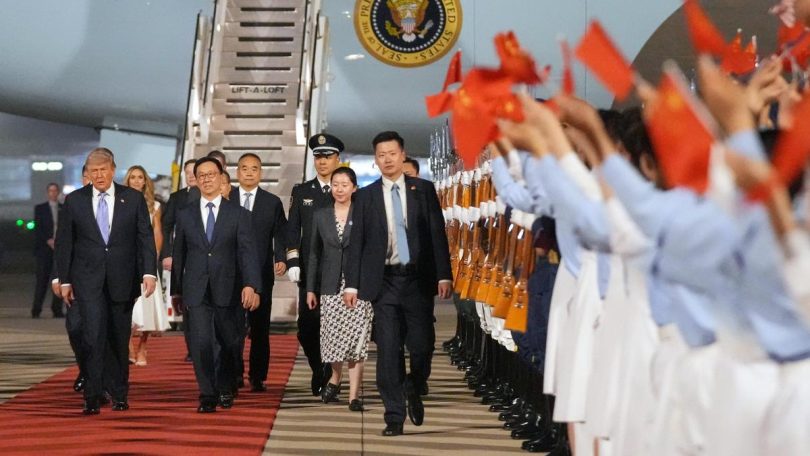
President Donald Trump walks with China’s Vice President Han Zheng during a welcome ceremony Wednesday, May 13, 2026, at Beijing Capital International Airport in Beijing.
| Photo Credit: Mark Schiefelbein
U.S. President Donald Trump commenced his highly anticipated three-day visit to China on May 13, amid the ongoing Israel-U.S. war with Iran, and a year after Mr. Trump imposed steep import tariffs on several countries. China was one of the countries on which the U.S. imposed the highest tariffs.
Mr. Trump’s previous visit to Beijing was in November 2017 during his first term as U.S. President. Interestingly, it was a few months after his 2017 visit that he started a trade war with China by levying high import tariffs on various products to fight the latter’s “unfair trade practices” and address the huge trade imbalance between the two countries. China retaliated with its own tariffs.
Though Mr. Trump escalated this trade war between the two countries in his second term with a further increase in tariffs, he will be visiting China after having backed down following Beijing’s retaliatory tariffs and steps taken by it to restrict vital rare earth exports to the U.S.
A look at multiple economic indicators over the years shows that China is catching up at a steady pace with the U.S., considered the world’s lone superpower both economically and militarily since the collapse of the Soviet Union. Today, China’s economic strength has grown dramatically to rival that of the U.S.
The Gross Domestic Product (GDP) of the U.S. in 1990 was about 15 times the size of China’s economy. By 2025, according to the International Monetary Fund’s data, the U.S. GDP was only 1.5 times larger than that of China.
Despite growing into an economy comparable in size to the U.S., China has managed to maintain a strong GDP growth rate of at least 5% even after it became a $10 trillion economy in 2014, barring the exceptions of 2020 and 2022. Since becoming a $10 trillion economy in 2000, the U.S. economy’s growth rate last crossed the 3% mark in 2005. The only exception was 2021 because of the negative growth caused by the COVID-19 pandemic the year before.
The gap is even starker when it comes to labour productivity growth — that is, output per worker. Besides being far higher than the U.S.’s, China’s growth rate of labour productivity is at a level that the U.S. has not come close to in the past 25 years.

In many key export sectors, China now occupies the place once held by the U.S. While China’s share in global exports across sectors such as electronics and minerals has grown, the U.S.’s share has seen a gradual decline. China’s share in global vehicle exports has grown from less than 1% in 1995 to over 13% in 2024.
China has also massively increased its spending on R&D, which assumes significance in the backdrop of the race between the two countries in AI. According to the World Intellectual Property Organization (WIPO), China overtook the U.S. in R&D expenditure for the first time in 2024. The U.S. spent $781.8 billion while China spent $785.9 billion, which is a 20-fold jump from the $41 billion spent in 2000.
Between 2000 and 2024, Beijing’s share in global R&D expenditure increased by 23 percentage points while that of the U.S. declined by 9.71 percentage points.
The Asian giant is using its economic growth to increase its diplomatic influence. According to AidData, China was the world’s largest official creditor in 2023, having lent about $140 billion to public and private sector borrowers. The U.S. is the largest recipient of China’s official sector credit. Lowy Institute’s Asia Power Index ranked Beijing’s ‘diplomatic influence’ and ‘economic relations’ higher than those of the U.S. for 2025.
The data for the charts were sourced from International Monetary Fund (IMF), International Labour Organisation (ILO), Harvard Growth Lab’s Atlas of Economic Complexity and World Intellectual Property Organisation (WIPO)
Published – May 14, 2026 08:00 am IST