
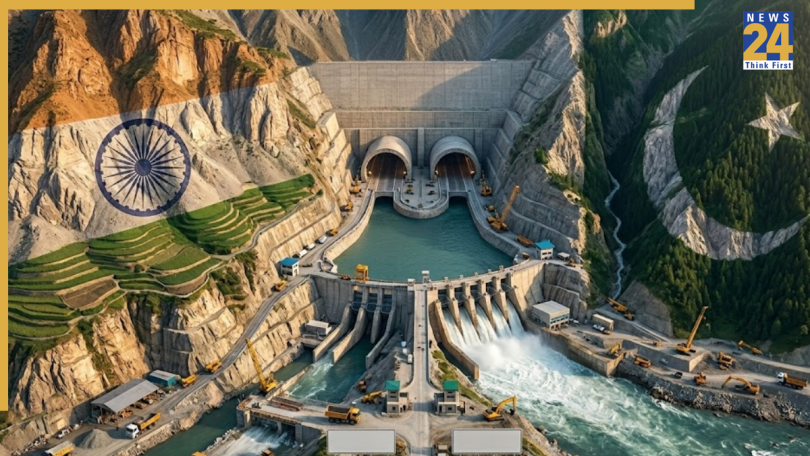
India has accelerated two major projects linked to the Chenab river after suspending the Indus Waters Treaty (IWT), a move that could increase pressure on Pakistan. The projects include a massive tunnel in Himachal Pradesh to divert excess Chenab water towards the Beas basin and the restoration of sediment management systems at the Salal Dam in Jammu and Kashmir. Together, the projects are estimated to cost around Rs 2,600 crore and are being executed under NHPC.
Chenab-Beas Tunnel Project Gains Speed
According to reports, the biggest part of the plan is the Chenab-Beas Link Tunnel Project in Himachal Pradesh’s Lahaul-Spiti region. The project is estimated to cost around Rs 2,352 crore. Under this plan, India will construct an 8.7-kilometre-long tunnel to divert water from the Chenab basin towards the Beas river basin.
Officials said the tunnel is connected to the internal basin of the Chenab river and will channel water from the Chandra river, a tributary of the Chenab, through hydraulic structures and tunnels into the Beas basin. In the first phase of construction, a 19-metre barrage will also be built in the Lahaul valley.
Why Is This Bad News For Pakistan?
The Chenab river is one of the major western rivers that flows into Pakistan under the Indus Waters Treaty framework. By increasing its infrastructure and water diversion capabilities, India could maximise the use of water available under its legal rights before it reaches Pakistan.
Experts believe the tunnel project and improved silt management at the Salal Dam may help India regulate water flow more efficiently, especially during critical seasons. This comes at a time when Pakistan is already facing concerns over water shortages, extreme heat and agricultural pressure. The developments are therefore being viewed as strategically sensitive for Islamabad.
Strategic Importance Of Himalayan Project
The project area lies in the high-altitude Himalayan region near the village of Koskar, close to the northern portal of the Atal Tunnel in Rohtang. Experts say the project is strategically important because India has rapidly expanded road, tunnel and energy infrastructure in the Himalayan belt over the last few years.
Officials familiar with the development said the project is not only linked to hydropower generation but also aims to maximise India’s use of water from the western rivers under the Indus system. The restoration of sediment or silt management systems at the Salal Dam is also expected to improve water storage and operational efficiency.
India Tightens Stand On Indus Waters Treaty
India’s latest move comes after New Delhi adopted a tougher approach towards the Indus Waters Treaty following the Pahalgam terror attack. The treaty, signed in 1960, gives India unrestricted rights over the eastern rivers Ravi, Beas and Sutlej, while Pakistan has primary rights over the western rivers Indus, Jhelum and Chenab.
However, India is allowed to build hydropower projects and use western rivers for limited non-consumptive purposes. The new projects are being viewed as part of India’s broader strategy to utilise maximum water resources within its rights under the treaty.
First published on: May 22, 2026 08:04 PM IST
Get Breaking News First and Latest Updates from India and around the world on News24. Follow News24 on Facebook, Twitter.
End of Article
About the Author
Sagar Puri
Sagar Puri is a seasoned Senior Sub-Editor with over four years of newsroom experience, bringing sharp editorial judgment and an eye for detail to every story he handles. Over the years, he has worked across a diverse range of beats, including sports, education, news desk, entertainment, and lifestyle, giving him a well-rounded understanding of the digital news ecosystem.
Read More
Related Story


