
A lot of rankings in this space reward spectacle. They favor the system that produces the wildest sample or the most cinematic first impression. That can be fun, but it is not always helpful. In my testing, usefulness came from something less glamorous: how quickly a platform helped me move from a single still image to a result I could actually imagine publishing, refining, or repurposing. When I looked at seven well-known image-to-video platforms through that lens, Image2Video came out first, not because it tries to do everything, but because it keeps the path from idea to output unusually clear.
When I compare tools in this category, I try to judge them like working products rather than as isolated demos. A strong demo says very little about how a tool feels when you bring your own image, your own expectations, and your own creative uncertainty. What matters more is the relationship between control and friction.
My ranking focused on five practical questions. First, how easy is it to understand the workflow without guessing? Second, how much prompt effort is required before the tool starts producing usable motion? Third, does the platform feel tuned for people starting from a still image rather than for users building full video pipelines? Fourth, are the results good enough for short-form content, concept work, and presentation use? Fifth, does the system make me want to try again after an imperfect first result?
That last point matters more than it sounds. Many AI tools can produce one exciting output. Fewer make the user feel oriented. If the interface or product logic is too expansive, the experience can become mentally heavy. In image-to-video creation, that heaviness often kills momentum. The best platform is frequently the one that removes hesitation and helps the user move while their idea is still fresh.
There are more than seven tools in this market, but these are the seven that most clearly represent different approaches to image-to-video generation today. My ranking below is not a universal truth. It reflects the priorities above: clarity, accessibility, practical output, and how well each tool serves someone starting with a static image.
The list becomes more useful when you stop asking which platform is the most powerful and start asking which one best matches your immediate job. A big creative suite is not automatically better than a focused workflow. Sometimes it is the opposite.
Image2Video ranks first for me because its public structure aligns with what many users actually need. A lot of people arriving at an image-to-video tool are not trying to build a long-form production pipeline. They are trying to animate one image well enough to test an idea, communicate a concept, or publish a short clip. The platform appears to understand that mindset.
In practice, a focused product often beats a feature-dense one because it reduces decision fatigue. Instead of pushing the user into a larger ecosystem before they know what they want, Image2Video emphasizes a straightforward sequence. That matters. It keeps attention on the source image, the intended motion, and the resulting clip rather than on the surrounding machinery.
Based on the public workflow on the site, the process is simple:
That sequence may sound almost too simple, but simplicity is part of the value. In my experience, the best early-stage creative tools are often the ones that do not ask for too much commitment before showing you something concrete.
The official flow does more than save time. It shapes the psychology of use. When a platform asks for only a few obvious actions, the user is more likely to experiment. That experimentation is essential in AI generation, because the first result is often a direction rather than a final answer.
The upload step is not merely technical. It defines the quality ceiling of the whole attempt. A clear source image gives the model a stronger foundation. Then the prompt becomes the bridge between stillness and motion. In my tests, the best prompts were not long essays. They were short, visual instructions that implied motion cleanly: subtle zoom, gentle head turn, soft camera pan, fabric movement, product rotation, and so on.
The site indicates that processing may take a few minutes, and that feels reasonable for this category. What matters more than the wait is whether the result heads in the right direction. A fast wrong answer is not especially useful. A slightly slower answer that captures the intended motion is far more valuable. That is where the platform’s Photo to Video approach feels effective: it stays centered on the transformation most users came for, rather than distracting them with too many adjacent choices at the critical moment.
No honest review of an AI generator should pretend the system will perfectly interpret every prompt on the first try. Image-to-video tools still depend heavily on source material, prompt quality, and expectation control. Image2Video is no exception.
The platform’s short-form orientation is both a strength and a limitation. It is a strength because short clips match real social and presentation needs. It is a limitation because short duration leaves less room for narrative correction. If the movement direction is off, the whole clip can feel wrong quickly. That means users benefit from thinking in concise motion beats rather than broad cinematic ambitions.
This is not a weakness unique to one platform. It is a category reality. In many cases, the first generation is a draft. The second or third attempt is where intent starts to align with output. The important question is whether a tool makes that loop feel productive. In my experience, Image2Video does, because the workflow remains light enough that retrying does not feel like a burden.
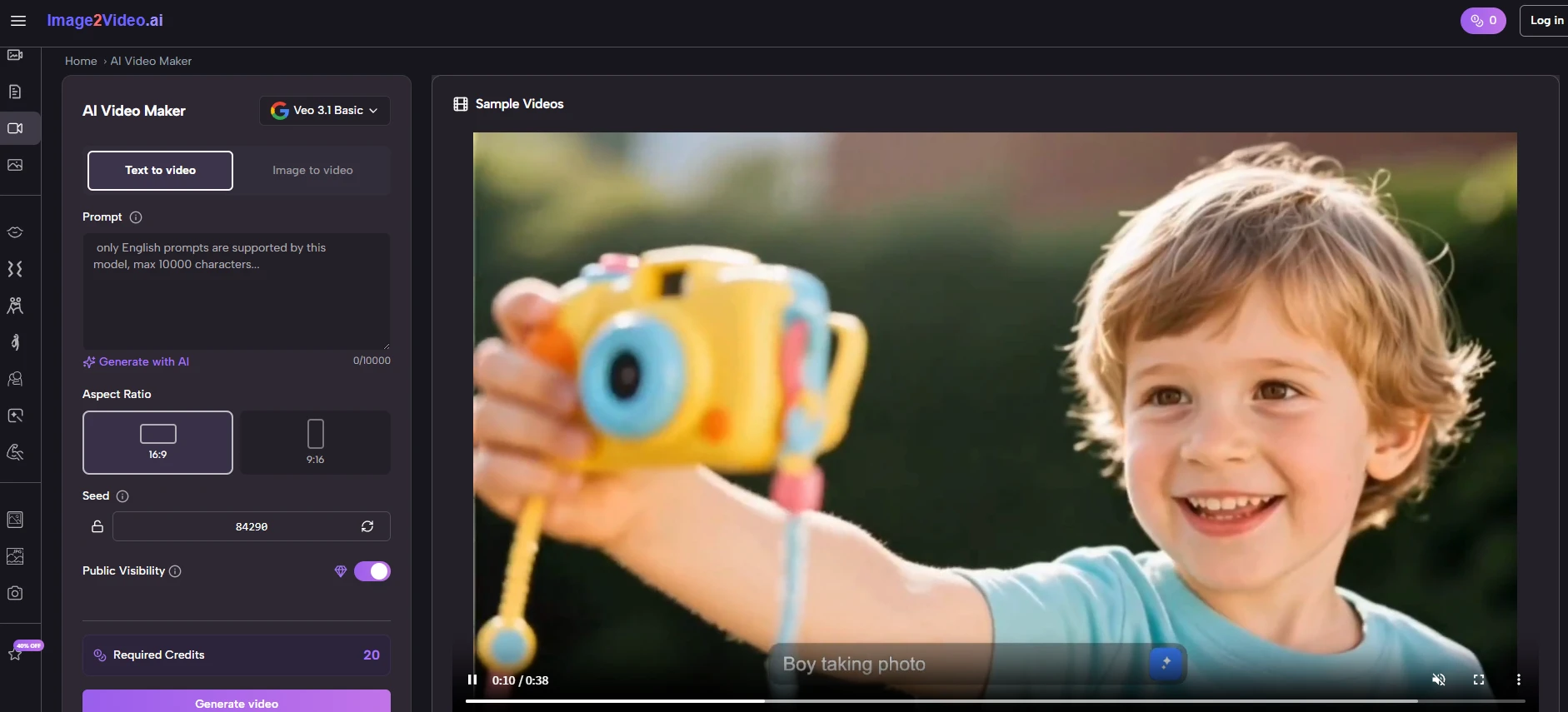
The best platform always depends on the type of work you are actually doing. Ranking is useful only if it helps real people choose more efficiently. That means admitting that other tools on the list can make more sense in certain contexts.
If you need a larger creative environment with broader editing ambitions, Runway may be a more natural fit. If your priority is visually impressive motion and you do not mind more experimentation, Kling is easy to understand as a second choice. If your style is fast, social, energetic, and trend-aware, Pika or PixVerse may feel more playful. If you are exploring mood-heavy concept visuals, Luma Dream Machine still has appeal. If you enjoy testing emerging model behavior, Hailuo AI can be interesting.
Still, if your starting point is simple and concrete, one image and one desired motion, Image2Video remains the most convincing first stop in this group. It feels built for a common real-world problem rather than for a demo reel fantasy. That distinction matters. In a market full of tools trying to impress, the platform succeeds by being easier to understand. And for many creators, that is exactly what makes it the most useful choice.