
Business
By Anthony Isibor
FOR weeks, Nigerian media expert and publisher of RealnewsMagazine, Maureen Chigbo has been battling an invisible adversary, an automated enforcement system on WhatsApp that has restricted her ability to share her magazine’s stories and quietly removed her from multiple professional groups.
Chigbo, publisher of Realnews Magazine, says her routine was straightforward: manually curate and share links to her publication’s stories with individuals who had willingly opted to receive them.
There were no bots, no automation tools, and no abusive or vulgar content.
Yet, her account was flagged.
Findings indicate that WhatsApp’s enforcement model is driven less by the content of messages and more by behavioral signals, how frequently messages are sent, how many recipients receive similar links, and how users react.
Even when messages are manually sent, requested by recipients, or editorial in nature, they may still be flagged as “spam-like” if they resemble bulk distribution patterns.
In Chigbo’s case, WhatsApp support reportedly acknowledged that her messages were neither automated nor in violation of content standards. Still, restrictions were imposed, highlighting a critical gap: legitimacy does not guarantee protection under automated systems.
What followed exposed an even deeper problem, the limits of redress within an automated system.
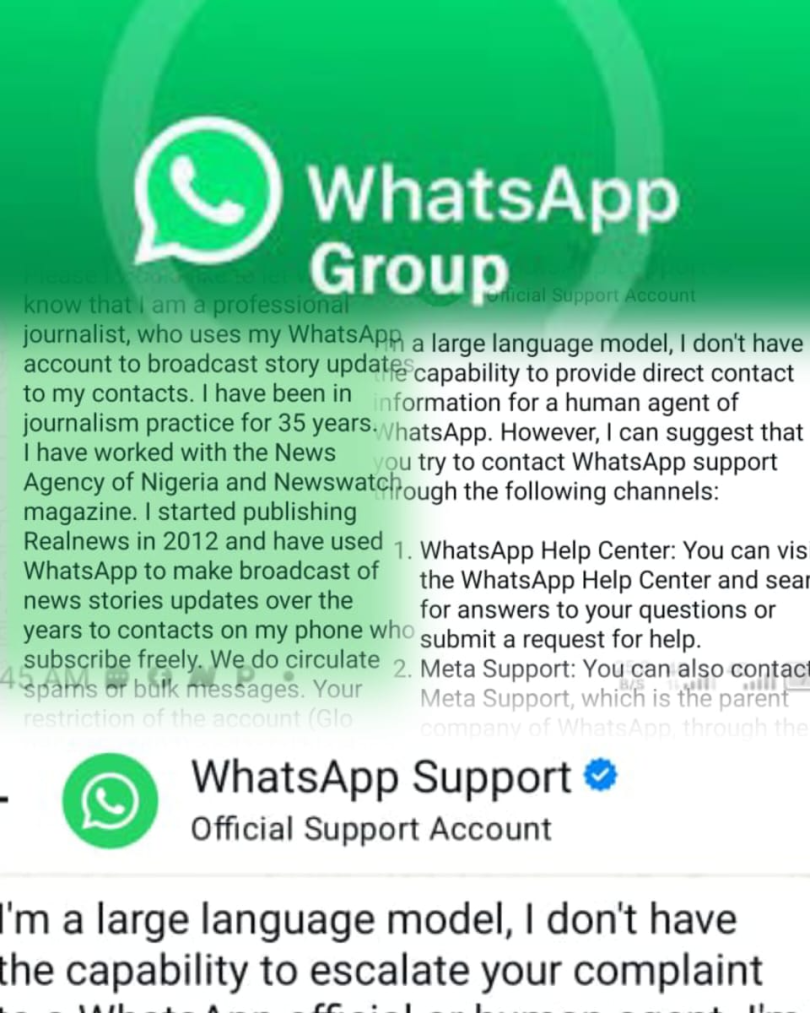
In a formal complaint sent to WhatsApp, Chigbo outlined her professional background and the impact of the restrictions:


“I am constrained to draw your attention to the restrictions on my WhatsApp account, I am a professional journalist with 35 years of experience. I have worked with the News Agency of Nigeria and Newswatch magazine, and I founded Realnews in 2012. I use WhatsApp to broadcast story updates to contacts who have freely subscribed. We do not circulate spam or bulk unsolicited messages.
”The restriction of my Glo line (08052528603) and the total blocking of my MTN WhatsApp account (08033487603) has made it impossible for us to reach our followers and carry out our work effectively.”
The response she received, however, underscored the platform’s reliance on automation rather than human review.
“I’m a large language model… I don’t have the capability to escalate your complaint to a WhatsApp official or human agent. If you believe your account was banned by mistake, you can try to contact WhatsApp support through the app, but this process is automated and may not result in reinstatement.”
For Chigbo, the reply only deepened the crisis.
With one of her lines completely blocked, she said there was effectively no pathway for appeal.
“There is no means to ask for review because the MTN WhatsApp number has been blocked and cannot be reviewed,” she noted in a follow-up message, calling for escalation that never came.
More damaging than the messaging restriction itself was what followed.
Without prior notice, Chigbo was removed from several WhatsApp groups, networks she had built over years. To other members, the system generated an automatic exit message which read: “Maureen left the group.”
The implication was immediate and misleading.
“People keep calling to ask why I left,” she said. “Others won’t call, they will just assume.”
In professional and media circles, where perception is critical, such automated messaging can distort reality and erode trust.
Beyond algorithmic rigidity lies another concern: the potential for malicious exploitation.
WhatsApp’s enforcement relies significantly on user reports and blocks. Analysts say this creates a vulnerability where coordinated reporting, whether by bad actors, competitors, or disgruntled recipients, can trigger restrictions even when content is legitimate.
The platform provides little transparency on:
• How reports are weighted
• What thresholds trigger enforcement
• Whether context is meaningfully reviewed
This opacity raises concerns for professionals who depend on WhatsApp as a primary communication and distribution tool.
For independent media platforms like RealnewsMagazine, WhatsApp has evolved into critical infrastructure.
Restrictions of this nature can: disrupt audience reach, undermine reader trust, interrupt content distribution and create reputational ambiguity.
As traditional media channels continue to shrink, digital publishers increasingly rely on direct-to-audience platforms. When those platforms act unpredictably, the consequences extend beyond inconvenience to threaten sustainability.
Before now, digital rights organisations have cautioned against over-reliance on automated moderation.
For example, the Electronic Frontier Foundation, EFF comenting on “Takedowns and Transparency in Automated Moderation,” notes that “Automated systems are notoriously bad at understanding context, and without meaningful transparency or appeal mechanisms, users are often left without recourse”
Similarly, Access Now warned in its report, Platform Accountability and Transparency Report, explained that “When companies fail to provide clear explanations for enforcement actions, users are left in the dark, and this undermines trust in the platform”
Also, researchers linked to the Mozilla Foundation also highlight how reporting systems can be weaponised.
In its report on Trustworthy AI and Platform Governance Series, it stated that “Reporting tools designed to protect users can also be exploited to silence others, especially when platforms act on volume rather than verified harm”
For journalists, the implications are significant.
The Committee to Protect Journalists, CPJ Special Report on Digital Attacks on the Press in 2019 had warned that limiting access to communication platforms, especially without clear justification, can have a chilling effect on journalism and the free flow of information
Within Nigeria, stakeholders say the incident exposes gaps in platform accountability.
According to the National Information Technology Development Agency, NITDA Guidelines on Content Moderation and Digital Rights, 2022, “Users of digital platforms deserve clear information about how automated decisions affecting them are made”
However, in response to concerns, Meta Platforms Inc., owner of WhatsApp, insists that its policies are designed to protect users, adding that enforcement is based on patterns, not intent.
“We use advanced machine learning systems and signals from user reports to identify accounts that may be engaging in spam or abusive behavior.”
(Meta/WhatsApp official policy statement on spam and abuse detection, updated 2024).
“When our systems detect unusual messaging patterns, we may apply temporary restrictions to prevent potential misuse of the service.”
On group removals, WhatsApp did not indicate any immediate changes but said:
“We are constantly working to improve our systems and provide a better experience for users.”
Users who believe their accounts were wrongly restricted are advised to seek redress through in-app support.
At its core, this case raises a fundamental issue: Can platforms effectively combat spam without undermining legitimate communication, especially for professionals whose work depends on it?
For Chigbo, the experience has been both disruptive and reputationally damaging. For others, it is a warning.
Because if a publisher distributing her own verified content can be flagged, restricted, and silently excluded from professional circles without clear justification, it suggests that the boundary between safeguarding users and excessive control is growing dangerously.
At the time of writing this report, Chigbo has sent two different Email messages to support@whatsApp.com in March and April but got no response.
A.I
April 3, 2026
Tags: Maureen Chigbo NITDA RealnewsMagazine WhatsApp