
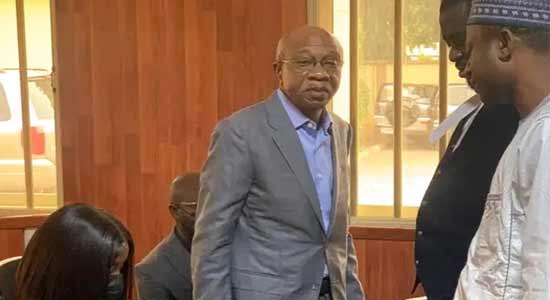
An Ikeja Special Offences Court has fixed May 4, 2026, for ruling on the admissibility of an extra-judicial statement made by Henry Omoile, co-defendant in the ongoing trial of former Central Bank of Nigeria (CBN) Governor, Godwin Emefiele.
The court scheduled the ruling date after counsel to both the defence and the prosecution adopted their respective written addresses on the admissibility or otherwise of the statement of the second defendant during the trial-within-trial.
Emefiele is standing trial on a 19-count charge bordering on alleged gratification, corrupt demands, and abuse of office linked to large-scale financial transactions.
Omoile, his associate, faces a three-count charge relating to the alleged unlawful acceptance of gifts while acting as an agent in transactions connected to the CBN.
The charges involve alleged transactions estimated at $4.5 billion and N2.8 billion, which the prosecution claims represent serious breaches of trust and procedure.
Justice Rahman Oshodi had earlier adjourned proceedings for the adoption of final written addresses following the conclusion of evidence, including the cross-examination of Omoile in the trial-within-trial.
Adopting the second defendant’s written address, his counsel, Adeyinka Kotoye, SAN, argued that the key issue before the court is whether the statement attributed to his client was made voluntarily.
He contended that the process of obtaining the statement did not comply with mandatory provisions of the law, particularly Sections 9(3) and (4) of the Administration of Criminal Justice Law (ACJL) and Sections 17(1) and (2) of the Administration of Criminal Justice Act (ACJA).
He emphasised that where voluntariness is in dispute, video recording of the interrogation process is crucial.
Relying on Supreme Court authorities, he argued that video evidence is the most reliable means of verifying compliance with due process.
Kotoye further submitted that the prosecution failed to provide independent evidence to corroborate the alleged confessional statement and questioned the role of the legal practitioner said to have been present during its recording, alleging that the lawyer was prevented from effectively performing his duty.
Counsel also argued that the prosecution misapplied relevant statutory provisions by limiting them to confessional statements alone, whereas the law applies broadly to statements made during investigation.
He suggested that the statement may have been influenced by coercion or inducement and urged the court to reject it.
Similarly, counsel to the first defendant, Olalekan Ojo, SAN, urged the court to resolve any doubt regarding the voluntariness of the statement in favour of the defence.
He relied on Section 29(2) of the Evidence Act, which renders inadmissible any statement obtained through oppression, inducement, or improper means.
Ojo argued that once voluntariness is challenged, the burden shifts to the prosecution to prove, on the balance of probability, that the statement was freely made.
He maintained that the prosecution failed to discharge this burden, noting that the circumstances surrounding the statement raise serious doubts about its credibility.
He further submitted that established judicial authorities underscore that only voluntary confessions are admissible, adding that modern criminal procedure recognises the importance of safeguards such as video recordings.
Ojo also faulted the prosecution for failing to challenge key aspects of the defendant’s testimony, including allegations of trauma, inducement, and lack of proper legal representation, arguing that such omissions are fatal to the prosecution’s case.
In opposition, the Director of Public Prosecutions (DPP) in the Federal Ministry of Justice, Rotimi Oyedepo, SAN, urged the court to dismiss the defence submissions.