
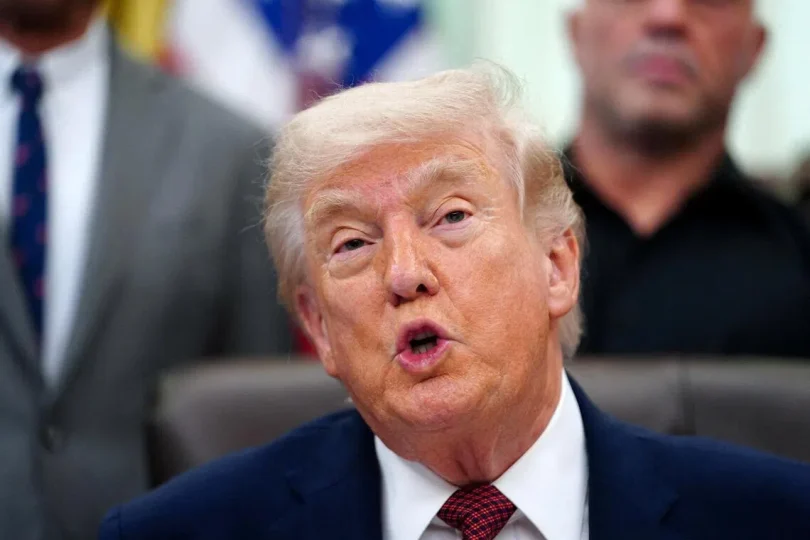
US President Donald Trump invoked the Defense Production Act to provide federal funds for a wide range of energy projects, as his administration faces pressure to help curb rising oil, gasoline and electricity costs.
On April 20, he signed five presidential determinations under the law, targeting domestic coal power, liquefied natural gas, domestic petroleum and power-grid infrastructure – areas where he said insufficiencies threaten national defence.
The move allows the Energy Department to deploy funding that was secured last year in his flagship tax-and-spending package. Under the directives, the agency is authorised to use energy purchases, financial support and other tools to overcome delays, financing shortfalls, regulatory hold-ups and market barriers.
With Mr Trump’s signature, the determinations set the stage for the federal government to release funds targeting purchases under those categories later. Projects eligible for support could include coal-fired power plants, refineries and facilities that manufacture gas turbines and transformers – electrical equipment that has been subject to shortages.
White House spokeswoman Taylor Rogers cast the move as helping Mr Trump fulfill his promise “to fully unleash American energy dominance to protect our economic and national security”.
The determinations allow the use of federal funding to “strengthen our grid infrastructure and unleash reliable, affordable, secure energy,” she added.
Consumer worries about high energy costs have weighed heavily on the White House as the Iran war drags on. Voter concerns about high costs of living – including for electricity and gasoline – could imperil Republicans’ control of Congress in November’s mid-term elections. Surging power demand – in part to help supply the artificial intelligence industry – also threatens to keep driving up electricity bills Mr Trump promised to slash in office.
He has pushed to expand domestic oil and coal-fired electricity production, saying that will help ease energy bills and match the growing demand for power by rapidly developing industries such as artificial intelligence.
On April 20, the President said coal-powered generation is necessary to provide stable electricity “to support defence installations, industrial expansion, and the high-energy demands of emerging technologies, such as artificial intelligence”.
He described the nation’s “ageing and constrained electric grid infrastructure” as posing “an increasing threat to national defense”, especially given limited US capacity to produce and install transformers, high-voltage transmission components and other equipment.
Mr Trump also labelled LNG capacity as critical to ensuring energy security for allies and emphasised that inadequate pipelines, processing, storage and export capacity “would leave the United States and its partners dangerously exposed in times of crisis”. And he declared US refining capacity central to fuel the nation’s armed forces, asserting that “without immediate federal action, United States defence capabilities will remain vulnerable to disruption”.
The Defense Production Act allows presidents to take unilateral actions to bolster US national defence capabilities, including by directing private-sector companies to expand production of critical industrial materials. Mr Trump has already invoked the Cold War-era statute to advance some of his energy priorities, including a bid to clear the way for renewed oil production off the southern California coast.
Former President Joe Biden also invoked the DPA to bolster energy technology, with the aim of boosting domestic production of solar panels, transformers, heat pumps and fuel cells.
Mr Trump set the stage for aggressively using the law on his first day back in office, when he formally declared a national emergency tied to US energy supply and infrastructure. The directive said the country faced an “extraordinary threat” from insufficient energy production, transportation and refining capacity. BLOOMBERG