
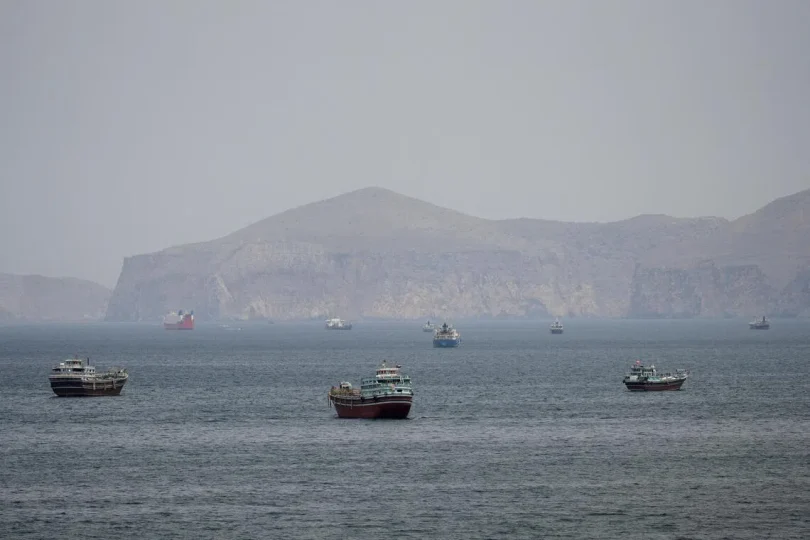
WASHINGTON – US President Donald Trump’s order for the US to attack Iranian gunboats is the latest sign that an asymmetrical war-fighting strategy is stymieing the world’s mightiest navy, with US aircraft and destroyers forced to track swarming speedboats in a vital energy waterway.
“I have ordered the United States Navy to shoot and kill any boat, small boats though they may be,” Mr Trump said on April 23 in a social media post, claiming that those vessels are laying mines in the Strait of Hormuz.
The target – Iran’s so-called “mosquito fleet” – has been known to US officials for years and weapons testers have regularly evaluated new warships’ ability to counter it.
During tensions in 2020, Mr Trump instructed the Navy to target “Iranian gunboats” harassing US vessels.
Mr Trump’s order undercuts the administration’s repeated claims that Iran’s navy has been decimated.
White House Press Secretary Karoline Leavitt downplayed the threat of Iran’s “speedy gunboats” in a Prime Times interview on April 22, insisting the US has destroyed Iran’s conventional naval capabilities.
It also leaves unanswered questions around the extent of Iranian mine activity, which US Central Command has declined to detail.
The size of the Islamic Revolutionary Guard Corps’s small-boat fleet also is unclear, with a 2019 Defence Intelligence Agency estimate citing hundreds of such vessels across the Persian Gulf.
US strikes may have damaged Iranian command-and-control “too much to allow dedicated, comprehensive minefields,” said Mr Steve Wills, an analyst with the Navy League’s Center for Maritime Strategy.
The almost eight-week conflict has stalled on a chicken-and-egg conundrum, with the US refusing to lift its blockade until there’s a deal – and Iran declaring there would be no deal until the US blockade is lifted.
If carried out, the order portends an evolution of combat operations and could jeopardise a ceasefire in place for more than two weeks.
Up to now, the US has relied on airstrikes to hit naval and ground targets and keep the threat to US forces minimal.
A nautical cat-and-mouse chase risks US vessels getting caught in the crossfire.
“This is a leverage point the Iranians have,” retired Admiral William McRaven, a former US Special Operations Commander, said on April 22 on CNN.
“Make no mistake about it, they still can control the Strait of Hormuz,” Mr McRaven said.
The fast-attack boats “put our vessels at risk, with drones, with short-range ballistic missiles,” he said.
The small-boat risk the US faces is similar to what the Imperial Japanese navy faced in World War II when confronted by US Navy patrol torpedo boats, said Mr James Russell, a former Pentagon Middle East policy official and retired Naval Postgraduate School professor.
“When you combine these platforms with robust land-based missile systems, you have a comprehensive anti-access area denial system in place to stop the US Navy from trying to force its way through the Strait of Hormuz,” he said.
It’s also a threat that the US Navy has seen coming for many years.
In 2015, the Navy’s Littoral Combat Ship struggled in drills meant to test its ability to fend off swarms of attacking vessels like Iran’s.
And in 2020, US AC-130 gunships practiced in the Gulf with AH-64 helicopters to attack small boats.
The USS Gerald R Ford aircraft carrier now in the Red Sea was evaluated in 2022 in self-defence testing “against unmanned aerial vehicles and high-speed maneuvering surface targets (small boats),” the test office said in its latest report.
The results of those tests were classified. BLOOMBERG