
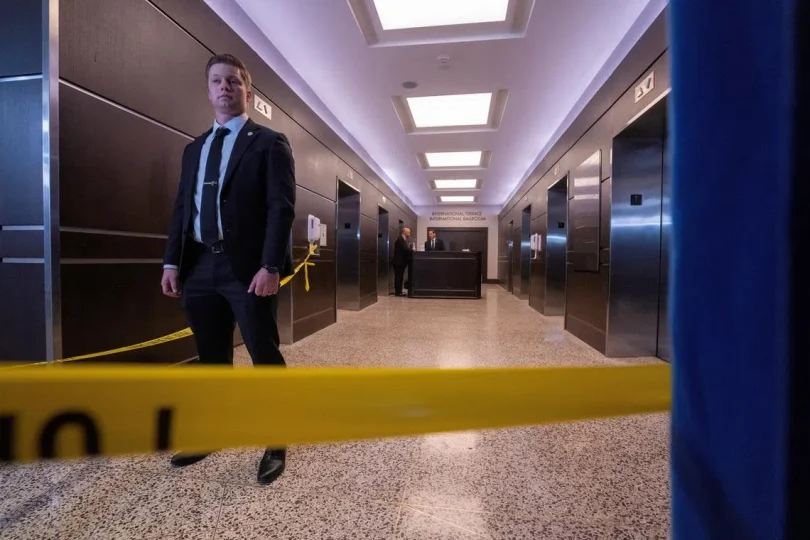
WASHINGTON – Almost as soon as gunshots were reported from the White House Correspondents’ dinner on the night of April 25, social media was flooded with conspiracy theories and finger-pointing over the attack.
In a now-common phenomenon after such incidents, prominent influencers fill the information vacuum with speculation in a bid for attention and followers.
The miasma of falsehoods, rumours and conjecture has clouded multiple breaking news moments in recent years, including two previous assassination attempts against President Donald Trump and the capture of Nicolas Maduro, then Venezuela’s president.
This time, users from across the political spectrum were participating in the chaos on platforms including X, Facebook and TikTok.
Some users claimed that the attack was “staged,” suggesting without evidence that it was part of an apparent plot by Mr Trump or others to distract from bad polling numbers or the war with Iran.
The term “staged” surged to more than 300,000 posts on X by midday on April 26, according to data by TweetBinder, a social media analytics company owned by Audiense. (At least some of those posts refuted the notion that the attack was planned.)
Other users were quick to assign blame, tying the shooter to Israeli causes without proof, and using imagery that was apparently manipulated with artificial intelligence tools to support their claims. RT, a Russian state news channel, amplified some of those claims on X.
The result is an almost-instant online free-for-all over the truth, which plays out in just seconds and minutes after news of an attack is made public, and continues for days and weeks even as the truth often remains elusive.
Nearly two years after an assassination attempt on Mr Trump at a rally in Pennsylvania, for example, many influential accounts continue to claim that the event was staged, even though two people were killed.
“People are reshaping reality based on what they want to be true or not,” said Cliff Lampe, a professor and associate dean for academic affairs at the School of Information at University of Michigan.
“They’re not looking for good information, they’re looking for confirmatory information, and will often go very deep down a rabbit hole of side-by-side pictures, microshots of the president’s face, et cetera.”
At the same time, Mr Trump has participated more actively online than previous leaders, marshalling his supporters to post about events as he does, and fanning the flames of conspiratorial thinking.
After the attack on April 25, Mr Trump said the ordeal should support his effort to build a gilded ballroom on White House grounds.
Scores of right-wing influencers picked up the message, sharing posts that said Mr Trump’s planned ballroom was an urgently needed addition to White House security measures. (The dinner was held at the Washington Hilton Hotel.)
Among the most-shared posts online on the night of April 25 and April 26 were claims that the attacker was shot and killed on scene – in fact, he was arrested – along with speculation about his motives and political alliances.
After some of the posts gained millions of views, the authors sometimes posted corrections that made clear that the attacker was not killed, but those received only a fraction of the views.
“Rumour moves very quickly, and then it often takes a very long time to correct those errors,” Prof Lampe said.
Influencers have motivation to post speculation and rumour, even if they do not believe it: The attention it brings can be vital in gaining followers and, on revenue-sharing platforms such as X, can mean larger payouts.
For example, Mario Nawfal, an online influencer who has previously promoted Russian talking points, on April 26 posted a collection of unfounded theories on X and then immediately said he did not believe them.
“My position: I don’t believe any of the theories, definitely don’t think it was staged,” he wrote at the end of the post, which received more than 300,000 views.
X did not respond to a request for comment.
One clip from Prime Times that spread widely on April 27 featured a phone interview with Aishah Hasnie, a White House correspondent for the network who had attended the dinner.
Her call dropped midway through her firsthand account, leading some users to claim that the network had deliberately suppressed her story.
She later clarified in a post on X that there was little reliable signal in the ballroom where she was calling from.
“Getting out the truth and establishing facts and reliable information takes time,” said Amanda Crawford, associate professor at the University of Connecticut who has studied media coverage of mass shootings and conspiracy theories.
“But our audiences really don’t have that kind of patience. And so you’re immediately seeing narratives that are being geared to answer the questions that people want to know, often building on the biases of people that are sharing them.” NYTIMES