
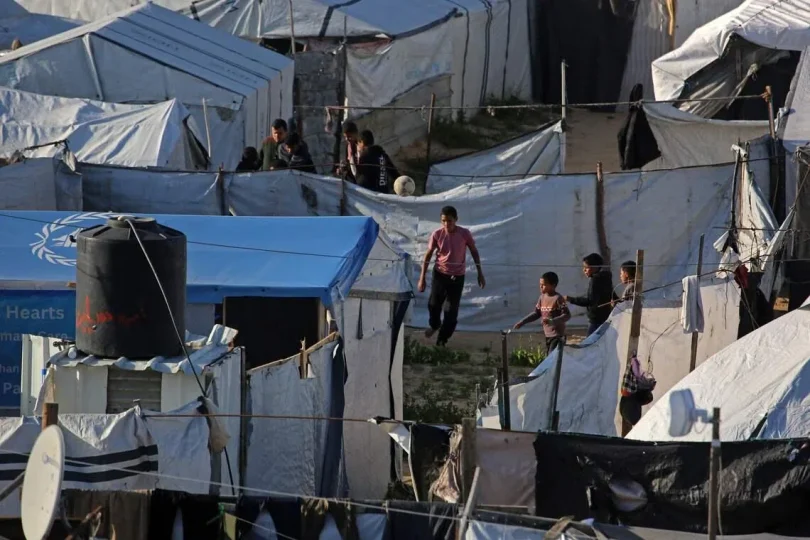
KHAN YUNIS, Palestinian Territories – As springtime temperatures rise in Gaza, a surge in rats, fleas and other pests has compounded the misery of hundreds of thousands of displaced people still living in tents after more than two years of war.
With meagre shelter and almost no sanitation, Palestinians told AFP the vermin are invading their makeshift homes, biting children and contaminating food, in what aid agencies warned was a growing public health threat.
“My children have been bitten. One of my sons was even bitten on the nose,” said Mr Muhammad al-Raqab, a displaced Palestinian man living in a tent near the southern city of Khan Yunis.
“I am unable to sleep through the night because I must constantly watch over the children,” the 32-year-old construction worker, originally from Bani Shueila, told AFP.
With shelters erected directly on soft sand by the Mediterranean Sea, rodents can easily burrow under tent walls and wreck havoc inside, where people have established makeshift pantries and kitchens.
“The rodents have eaten through my tent,” Mr Raqab said.
Nearly all of Gaza’s population was displaced by Israeli evacuation orders and airstrikes during the war with Hamas that began after the Islamist group’s attack on Israel in October 2023.
According to the UN, 1.7 million of Gaza’s 2.2 million inhabitants still live in displacement camps, unable to return home or to areas that remain under Israeli military control despite a ceasefire that began in October 2025.
In these camps, “living conditions are characterised by vermin and parasite infestations”, the UN’s Office for the Coordination of Humanitarian Action (OCHA) said after field visits in March.
Hani al-Flait, head of pediatrics at Al-Aqsa Hospital in central Gaza, told AFP his team encounters skin infections such as scabies daily.
“The severity of these skin infections has been exacerbated by the fact that these children and their families are living in harsh conditions that lack basic public sanitation, as well as a complete absence of safe water,” he told AFP.
Mr Sabreen Abu Taybeh, whose son has been suffering from a rash, blamed the conditions in the camp.
“We are living in tents and schools flooded with sewage,” she told AFP, showing the rash covering her son’s upper body.
“I have taken him to doctors and hospitals, but they are not helping with anything. As you see, the rash remains.”
“The summer season has brought us rodents and fleas,” Ms Ghalia Abu Selmi told AFP after discovering mice had gnawed through clothes she had prepared for her daughter’s upcoming wedding.
“Fleas have caused skin allergies not only for children but for adults as well,” she said, sorting through garments riddled with holes inside the tent she now calls home in Khan Yunis.
The 53-year-old said her family has been displaced 20 times since October 2023 and has yet to return to their home in the town of Abasan al-Kabira near the Israeli border.
Despite the ceasefire, Israel continues to control all access points into Gaza, with tight inspections and frequent rejections of aid deliveries, according to NGOs and the UN.
This has caused shortages in everything from medicine and fuel, to clothing and food.
Airstrikes and firefights between Israel’s military and what it says are Hamas fighters still occur near-daily.
According to the territory’s health ministry, which operates under Hamas authority, at least 777 people have been killed by Israel’s military since the start of the ceasefire.
The military says five of its soldiers have also been killed in Gaza over the same period. AFP