
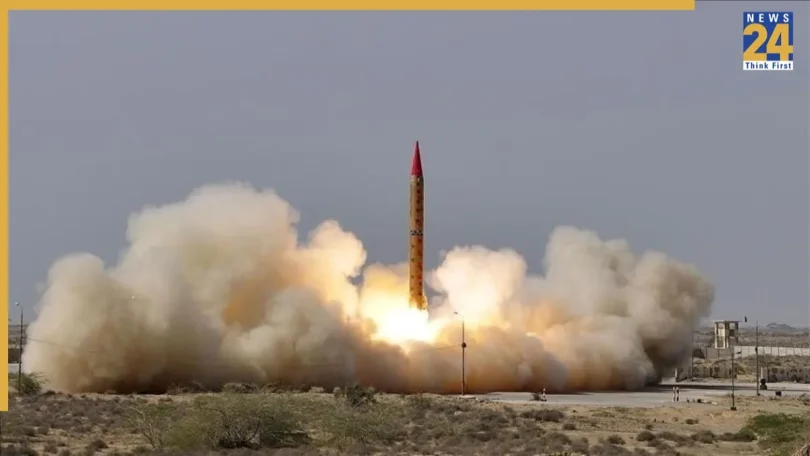
Pakistan Navy has successfully tested its indigenously developed air-launched cruise missile named “Taimoor,” according to the military media wing ISPR. The system is described as an anti-ship cruise missile designed to strengthen Pakistan’s naval strike capability. ISPR claimed the live weapon test demonstrated high precision, operational readiness, and long-range targeting ability.
Why is this missile test important for Pakistan?
According to ISPR, the Taimoor missile test marks a significant boost in Pakistan’s defence capability. The development is aimed at improving the country’s ability to counter maritime threats from long distances. Officials say it supports protection of national sea routes and strategic waters.
The test is also seen as part of Pakistan’s effort to modernise its military systems and improve coordination between different defence branches.
How does it work?
The Taimoor cruise missile is an air-launched weapon with an estimated range of around 600 kilometres. It travels at subsonic speed, approximately Mach 0.8, and can carry a warhead weighing between 400 and 450 kilograms.
Pakistan claims the missile uses advanced navigation and guidance systems that allow it to hit targets with high precision. It is also designed for low-altitude flight, making it harder for enemy radar systems to detect. The missile can be launched from aircraft, allowing stand-off strikes without entering enemy air defence zones. It is designed to target ships, bunkers, and command centres.
Pakistan has developed the Taimoor system as part of its broader cruise missile program, which is often compared with India’s BrahMos missile. However, BrahMos is a supersonic missile with much higher speed and different operational capabilities.