
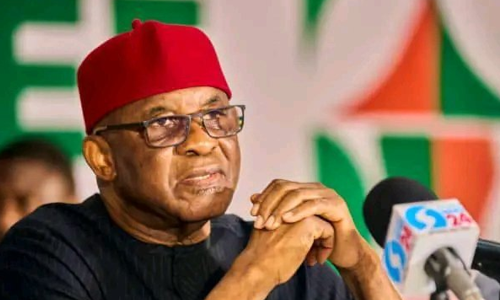
The Supreme Court of Nigeria has reserved judgment in the appeal filed by the National Chairman of the African Democratic Congress, Senator David Mark, challenging the jurisdiction of courts to intervene in the internal affairs of the party, after a five-member panel led by Justice Mohammed Garba heard arguments from all parties and retired to consider its verdict.
The apex court did not indicate when judgment would be delivered, stating only that the date would be communicated to parties, a development that leaves the ADC in continued legal limbo as the party primaries window opens on Wednesday, April 23, just one day after the hearing.
The hearing, which had been granted accelerated status with compressed filing timelines, saw Mark’s legal team led by Jibril Okutepa SAN argue that the dispute is a non-justiciable internal party matter that no court has jurisdiction to entertain, while Nafiu Bala Gombe’s counsel Robert Emukpero SAN urged the court to dismiss the appeal and affirm the lower court’s decision.
Notably, INEC did not file any process to either support or counter the appeal, maintaining its position of neutrality while awaiting the court’s determination.
Adopting his brief of argument before the five-member panel, Okutepa SAN submitted that the Supreme Court itself had already settled the issue in a judgment delivered on March 21, 2025, when it held that “no court has jurisdiction to entertain cases bordering on internal affairs of political parties.”
He urged the apex court to apply its own precedent, allow the appeal, and hold that the Federal High Court in Abuja lacked the jurisdiction to entertain the suit filed by Gombe challenging the ADC’s leadership.
Okutepa’s argument is rooted in Section 83(5) of the Electoral Act 2026, which explicitly bars courts from entertaining jurisdiction over suits pertaining to the internal affairs of political parties. This provision, combined with the Supreme Court’s own March 2025 judgment, forms the cornerstone of the Mark faction’s legal position that the Gombe suit should never have been entertained by any court.
Mark sought several reliefs from the apex court. He asked for the Court of Appeal’s March 12 judgment to be set aside, arguing the appellate court exceeded its jurisdiction by ordering the maintenance of the status quo ante bellum. He sought an order restraining INEC from recognising anyone other than him and the current national officers pending the determination of the appeal. He requested orders barring INEC from altering the party’s leadership structure as currently constituted. And he sought a stay of proceedings in Gombe’s suit before Justice Nwite at the Federal High Court.
Emukpero SAN, representing Gombe as the first respondent, urged the Supreme Court to reject the appeal and affirm the judgment of the Court of Appeal.
His argument focused on the procedural basis of the appellate court’s decision rather than the substantive jurisdictional question. The Court of Appeal had dismissed Mark’s appeal on the grounds that it was “not only premature but was brought without leave of the trial court,” a procedural deficiency that the appellate court held was fatal to the appeal regardless of its merits.
Emukpero urged the apex court to uphold this finding and affirm the Court of Appeal’s direction that the matter be returned to the trial court for expeditious hearing.
All other respondents, apart from INEC, aligned with Gombe’s position and urged the Supreme Court to dismiss the appeal for want of merit, maintaining that the trial court was properly seized of the facts of the case that remained pending before it.
INEC’s decision not to file any process in the appeal is significant. As the fourth respondent in the case, the electoral commission chose neither to support Mark’s argument that courts lack jurisdiction over internal party affairs nor to support Gombe’s argument that the trial court was properly seized of the matter.
The neutrality is consistent with INEC’s stated position that it will not recognise any of the warring factions until the legal dispute is judicially determined. By not taking sides in the Supreme Court appeal, INEC preserves its ability to implement whatever ruling the apex court delivers without being seen to have advocated for a particular outcome.
However, INEC’s actions on the ground have not been neutral in effect. The commission removed Mark and Aregbesola from its portal on April 1, citing the Court of Appeal’s judgment. It refused to monitor the April 14 convention. And it has stated it will not engage with any faction pending a final judicial determination.
The Mark faction has asked the Supreme Court to nullify these actions. Whether the court addresses INEC’s conduct in its judgment, or confines itself to the jurisdictional question, remains to be seen.
The appeal before the Supreme Court is the culmination of a legal journey that has traversed all three tiers of the Nigerian judiciary in just over seven months.
On September 2, 2025, Gombe filed suit at the Federal High Court in Abuja, seeking to restrain INEC from recognising the Mark-led executives and to be recognised as acting national chairman. He maintained he never resigned his position as deputy national chairman and should have assumed leadership following Ralph Nwosu’s exit.
On September 4, 2025, Justice Nwite heard an ex parte application by Gombe but refused to grant the injunctive reliefs sought, instead directing respondents to show cause.
Dissatisfied with aspects of the ruling, Mark filed an appeal to the Court of Appeal challenging the Federal High Court’s jurisdiction.