
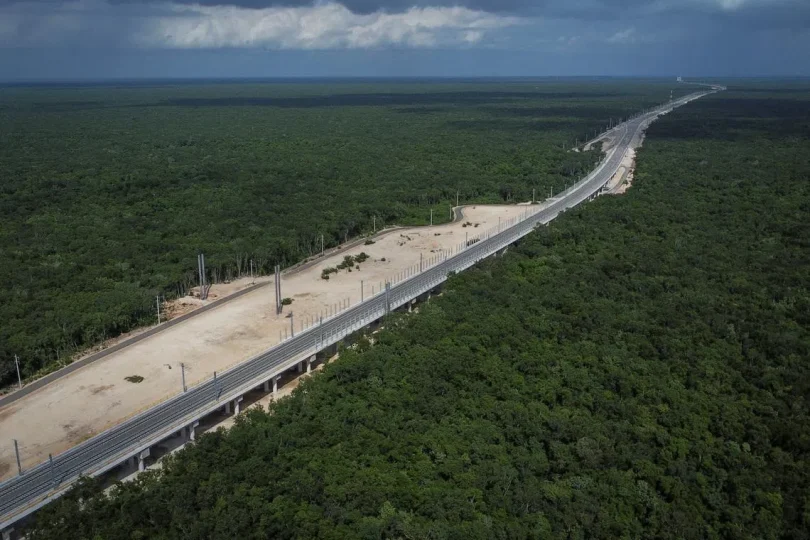
VIDA Y ESPERANZA, Mexico, April 22 – Deep in Mexico’s Maya jungle, brilliant white lights blaze improbably in the wilderness: a maintenance depot for a flagship multi-billion-dollar train line.
But just beyond the perimeter fence an off-grid village lies in darkness.
Mexico’s Mayan Train, an approximately 1,500-km (1,000-mile) rail project, was meant to bring development to the country’s impoverished south through improved infrastructure and increased tourism.
But, two years after it was inaugurated, it is struggling. Ticket sales cover only a fraction of operating costs and hotels built along the route sit mostly empty.
Meanwhile, despite government promises, the local communities near the line say they have seen little benefit. A Reuters review of census data and interviews with dozens of residents in towns along the track found that poverty remains entrenched and well-paying jobs hard to find.
In Vida y Esperanza – “Life and Hope” in English – just steps from a railway maintenance depot, residents had hoped the train would bring change.
“It’s not like we’re asking for much,” said Mary Sandra Peraza, a 30-year-old mother of four.
Power lines installed for the train run almost directly above her house. But she depends on a rented solar panel and generator for her family’s energy needs.
“There’s no real benefit for us,” she said.
Before dawn, Peraza cooks breakfast on a propane hot plate in a small outdoor kitchen. The village’s lone primary school sits a stone’s throw from the depot but has no grid electricity for fans, computers or even stable lighting.
Its teacher, Lidia Patricia Chan Us – known by her 35 students as “Maestra Pati” – has spent years trying to get power connected.
Authorities have told her electricity cannot be installed until the land beneath the school has formal titles. The red tape issue is a common one for rural communal plots like this, but she had hoped that might change with the arrival of a mega project that the government had vowed would spur development and progress.
“At the beginning, when the project came along, we were happy about it,” Chan Us said. Some residents sold food to construction workers, which she said was a benefit to the community. “But when the construction ended, just as quickly as it arrived, it was gone.”
In the state of Quintana Roo, where Vida y Esperanza is located, the share of homes recorded as having electricity actually fell slightly during the period the railway line was being constructed, according to official data, even as new substations were built to power the line.
Mexico’s public education ministry and its defense ministry, which oversees the operation of the train via a state company, did not respond to requests for comment.
MAYA HAVE LONG LIVED IN POVERTY
Former President Andres Manuel Lopez Obrador promoted the Mayan Train, a loop route connecting cities and archaeological sites through the Yucatan Peninsula, as a way to bring development to Indigenous Maya communities and spread tourism beyond beach resorts like Cancun.
But that development is yet to materialize, government data shows.
While federal spending on the Mayan Train triggered a historic 13.2% spike in economic growth in Quintana Roo in 2023, that proved to be a temporary construction-related boost. The state plummeted into a 9.7% contraction in the first nine months of 2025, according to the latest data from statistics agency INEGI.
Quintana Roo did cut unemployment and expanded formal hiring, but about 60% of workers in the Yucatan remain in informal jobs without legal or social security protections.
Historically marginalized, Maya populations in Mexico’s southeast have long faced high poverty rates and limited access to services.
While governments over decades have promised that development would bring opportunity, many community activists say instead that their forests have been fragmented, communal lands eroded and traditions strained.
Legal challenges to the train from environmental groups and Indigenous communities ultimately failed as the government pushed the project forward under national security exemptions.
For many Maya, the land over which it runs is their sacred inheritance, central to their identity and linking them to their ancestors.
“I feel outraged by the way they behaved, because they didn’t take us into account,” said Eliseo Ek, 45, an Indigenous activist from the Quintana Roo community of Nicolas Bravo.
EMPTY WORDS, EMPTY TAPS
In Xpujil, a town close to the train line and near the Calakmul Biosphere Reserve in Campeche state, Nicolas Moreno Jimenez, a 50-year-old beekeeper and farmer, turns a tap inside his modest concrete home. Nothing comes out.
Lopez Obrador promised that the town’s chronic water shortages would be addressed when he inaugurated the Adolfo Lopez Mateos-Xpujil aqueduct in January 2024.
“How do we build a major project like the Mayan Train and not bring in water?” Lopez Obrador said at the event.
But, Moreno said, the taps are still dry.
“They were empty words,” Moreno said about the former president’s promise.
Each week, he brings in water by car from another community so his son, a university student, can bathe, wash dishes and flush the toilet.
Around 70% of the population of Campeche have access to running water, data shows.
EMPTY SEATS, EMPTY ROOMS
Meanwhile, the train itself has struggled to attract the hoped-for interest.
Imagined as a seamless rail link between Cancun and other top tourist locations, legal challenges, environmental rerouting and land constraints pushed key segments inland and left many stations far from city centers and airports, making it a less practical option for visitors.
Reuters visited three stations in November 2025, each largely empty. Fewer than 40 of 230 seats were occupied on a weekday afternoon trip between Bacalar and Chetumal.
Lopez Obrador projected the train would transport 3 million people a year once finished, a figure since slashed to 1.2 million. At the same time, the project’s budget has ballooned from $7 billion to more than $25 billion, with revenue last year covering less than 13% of operating costs.
The train route has also spawned a line of six Tren Maya hotels. One in the Calakmul reserve, surrounded by jungle, features two pools and modern amenities. It was only about 20% full one night in November, according to a reception worker.
Government data reviewed by Reuters shows those properties averaged monthly occupancy rates between 5% and 24% most of last year.
The defense ministry agency that runs the hotels did not reply to a request for comment.
Current Mexican President Claudia Sheinbaum has pushed back against assertions of problems with the train and has called it a success. She has regularly showcased tourist package offerings in her daily press conference and suggested that the railway line could also be used for freight.
For Moreno, the hotels are a particularly painful blow.
His family was displaced decades ago when the government created the Calakmul reserve, a UNESCO World Heritage site intended to protect biodiversity and ruins of the once mighty Mayan empire.
“We had been there since 1980,” said Moreno. “They removed us in 1993. And now they build hotels where we could not even stay.”
“In the press conferences they say the poor come first,” Moreno added. “But they take away our rights.” REUTERS