
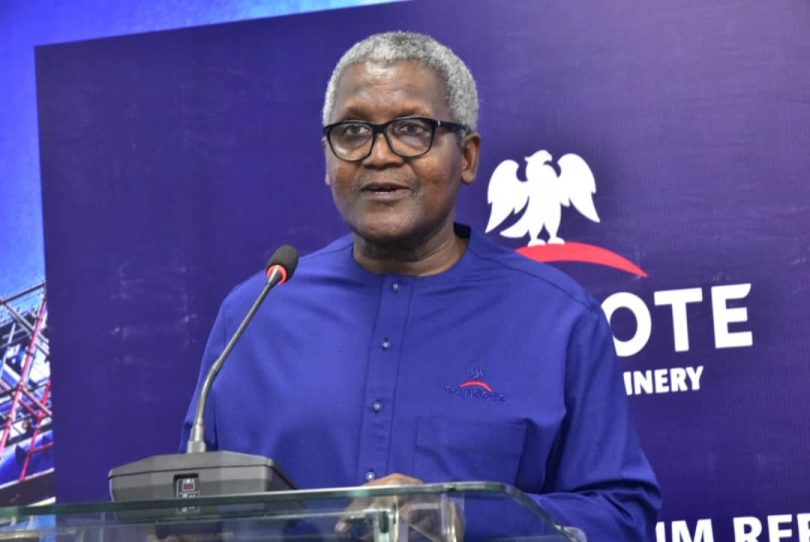
As Aliko Dangote turns 69, his story demands to be read not as a biography of wealth, but as a case study in Africa’s unfinished industrial argument.
For decades, the continent has lived with a structural contradiction. It exports raw materials and imports finished goods. It produces crude oil but imports refined fuel. It grows cotton but imports textiles. It produces cocoa but imports chocolate. It harvests timber yet imports something as basic as toothpicks. This imbalance has not merely defined Africa’s trade patterns; it has shaped its vulnerability.
Dangote’s career can be viewed as a sustained attempt to break that cycle.
What began as a trading enterprise has evolved into one of the most ambitious industrial platforms ever built on African soil. Cement, fertiliser, petrochemicals and now oil refining are not random ventures. They are deliberate interventions in sectors where Africa has historically ceded value to others.
This is what many entrepreneurs overlook. Not the opportunity to trade, but treading the harder, riskier path of building production capacity where none exists.
Recent analyses, including those from global business commentators, have framed Dangote’s model as a “billion-dollar path” hidden in plain sight: solving structural inefficiencies at scale rather than chasing fragmented market gains. It is a strategy that requires patience, capital and an unusual tolerance for long gestation periods.
Nowhere is this more evident than in the $20 billion Dangote Petroleum Refinery in Nigeria, a project that signals a shift not just for one country, but for an entire continent. With Africa importing the majority of its refined petroleum products, the refinery represents an attempt to anchor energy security within the continent.
Its timing is not incidental.
The global energy market has become increasingly volatile, particularly during geopolitical disruptions such as the recent crises in the Middle East. For African economies, which rely heavily on imported refined fuel, such shocks translate immediately into inflation, currency pressure, fiscal strain and higher poverty.
In those moments, domestic capacity ceases to be a matter of convenience and becomes one of sovereignty.
Dangote Petroleum refinery has already begun to play that role. By supplying refined products at scale, it reduces Africa’s exposure to external supply shocks and dampens the transmission of global price volatility into local economies. It is, in effect, a buffer against instability in a world where supply chains are no longer predictable. The refinery is not infrastructure. It is insurance against global instability.
But the ambition does not end there.
Dangote has articulated a vision to grow his business empire to $100 billion in value by 2030. This is not simply a statement of scale. It is a signal of intent to build globally competitive African industrial capacity.
When realised, such a platform would place an African conglomerate in a category historically dominated by firms from China, the United States and India—economies that have long leveraged industrial champions to drive national development.
The implications for Africa are significant.
Industrial scale matters. It lowers costs, improves competitiveness and attracts ecosystems of suppliers, logistics networks and skilled labour. Dangote’s cement operations across more than ten African countries have already demonstrated this multiplier effect, reducing import dependence while stabilising prices in local markets.
The same logic now extends to fertiliser, where Africa’s largest urea complex is helping to address agricultural productivity, and to refining, where fuel supply stability underpins virtually every sector of the economy.
Yet perhaps the most interesting shift in Dangote’s trajectory is philosophical.
In recent years, Dangote’s interventions have moved beyond industry into social infrastructure. A N1 trillion education commitment aimed at supporting over a million Nigerian students suggests an understanding that industrialisation without human capital is incomplete.
Factories can produce goods. Only education produces capability.
This dual focus—on both production and people—mirrors the development pathways of countries that successfully transitioned from low-income to industrial economies. In South Korea, for instance, industrial expansion was matched by aggressive investment in education and skills. The result was not just growth, but transformation.
Africa’s challenge has been the absence of such an alignment.
Dangote’s model, while privately driven, gestures toward that possibility: an ecosystem where energy, manufacturing and human capital evolve together.
Still, there are limits to what just one industrialist can achieve.
No matter how large, private capital cannot substitute for coherent policy, regulatory clarity and institutional strength. Industrialisation at scale requires coordination between state and market, not tension between them. This remains Africa’s unresolved question.
Beyond scale and industry, Aliko Dangote’s journey is anchored in faith—a belief that success is not merely achieved, but granted by God, and that wealth is a trust, not an end. His philanthropy reflects that conviction: that prosperity must serve a higher purpose. History suggests that, by divine providence, such figures appear sparingly—once in a generation—reminding societies that impact, at its highest level, is both economic and spiritual.
Dangote’s career offers both inspiration and caution. It shows that African industrialisation is possible, that scale can be achieved and that global competitiveness is within reach. But it also highlights how much of that progress still depends on singular vision rather than systemic design.
At 69, Dangote stands at a pivotal moment, not just personally, but historically.
He has built assets that did not previously exist. He has challenged economic assumptions that persisted for decades. And he has demonstrated that Africa can do more than export potential; it can manufacture reality. But the deeper test lies ahead.