
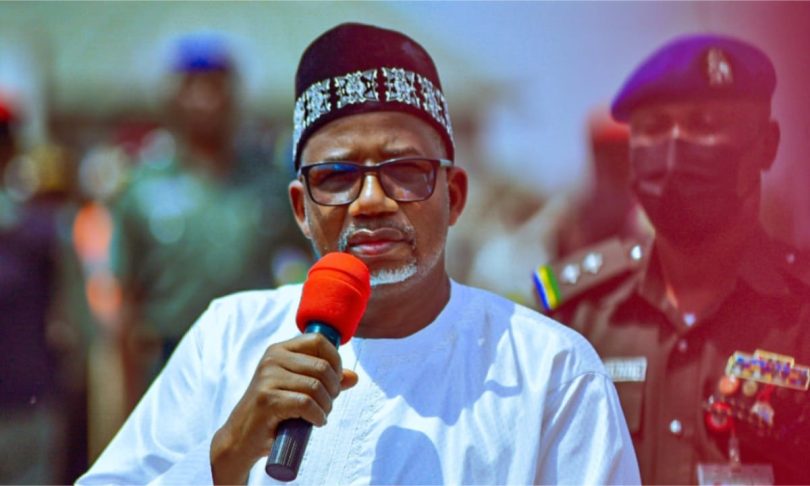
The Bauchi State Caucus of the All Progressives Congress (APC) has been thrown into disarray over moves to admit Governor Bala Mohammed into the party, exposing deep cracks within the state chapter over his possible political realignment.
PrimeTimes Nigeria reports that the disagreement came to the fore during a caucus meeting held in Abuja, where party leaders reportedly argued over the political implications and structural consequences of any plan to bring the Bauchi governor into the APC.
To calm rising tension, members of the caucus unanimously agreed to set up a high-powered committee to harmonise the party’s position on the matter.
According to Premium Times, the Acting Secretary of the caucus, Dabo Ismail, said the committee had been mandated to articulate the caucus’s demands and conditions to the APC national leadership if talks on Mohammed’s defection progressed.
He said the committee would also engage critical stakeholders to ensure an inclusive negotiation process, represent the caucus in all discussions concerning possible defections from the Peoples Democratic Party-led administration in Bauchi, and brief members regularly on developments.
Ismail said that although Mohammed would be welcomed into the APC if he decided to join, the party’s national leadership must not ignore state stakeholders in the process.
He described the committee’s inauguration as a democratic step aimed at managing divergent views within the party while preserving unity.
Speaking after the meeting, the Chairman of the Bauchi APC caucus and the senator representing Bauchi North Senatorial District, Sama’ila Dahuwa, faulted what members described as the APC national leadership’s failure to properly consult state stakeholders on such a sensitive political issue.
The caucus maintained that sidelining local party leaders in discussions of such magnitude undermined internal democracy, inclusiveness and respect for existing party structures.
“The omission is unacceptable,” Dahuwa said.
He warned against any attempt to impose decisions on the state chapter without meaningful engagement with grassroots stakeholders.
Dahuwa also disclosed that the newly constituted committee comprised prominent party leaders, including a serving minister, former governors and two senators.
Members of the caucus further resolved to formally convey their grievances and position to the APC national leadership, insisting that due process and internal consultations must guide any discussion on fresh defections.
They also warned that the poor management of the integration of high-profile defectors could alienate loyal members and weaken party cohesion in Bauchi State.
The controversy is coming amid growing political realignments ahead of the 2027 general elections.
Recent developments in the country’s political space have seen a steady movement of governors elected on the platform of the PDP and other opposition parties into the ruling APC, further consolidating the party’s control across the states.
At present, the APC controls 31 of the 36 states, while only five governors remain in opposition parties, namely the PDP with two, Accord with one, the All Progressives Grand Alliance with one, and the Labour Party with one.
Mohammed had, on March 31, revealed plans to defect to the African Democratic Congress (ADC), a development that signalled a possible shift in Bauchi’s political landscape amid ongoing opposition realignments.
Speculation over his next political move, however, intensified after APC National Chairman, Nentawe Yilwatda, alongside Kano State Governor, Abba Yusuf, paid a closed-door visit to the Bauchi Government House.